
Shore A hardness for O-rings and hydraulic seals affects how easily an elastomer deforms, follows the sealing surface, resists extrusion, contributes to friction, and behaves during installation. It matters, but the correct value cannot be selected from pressure alone. Compound, groove or profile geometry, clearance, motion, temperature, media, surface condition, tolerances, and installation method all change what an appropriate hardness needs to do.
That is why “use a harder seal for higher pressure” is only a starting hypothesis, not a universal rule. A harder compound may improve resistance to local deformation in the right geometry, while a softer compound may conform more readily to surface and dimensional variation. The practical task is to decide which failure risk matters most, then validate hardness inside the actual material and seal design.
Treat durometer as a system variable, not a stand-alone performance grade.
Define geometry, pressure and clearance first. Then check surfaces, motion, installation, temperature and media. If an extrusion or leakage problem is really caused by hardware, support, or an unsuitable profile, changing hardness alone may simply move the failure somewhere else.
What Shore A durometer tells you—and what it cannot tell you
Durometer is a measure of indentation hardness. In practical terms, it describes how strongly an elastomer resists a standardized indenter pressing into its surface. A higher Shore A value indicates a harder response to that indentation; a lower value indicates a softer response.
That information is useful because local deformation matters in sealing. A seal that deforms readily may follow small surface or dimensional variations more easily. A harder material generally resists local shape change more strongly and may be less willing to enter an unsupported clearance gap.
However, O-ring Shore A hardness is not a complete description of a compound. It does not independently define chemical compatibility, compression behavior, friction, abrasion resistance, tensile behavior, thermal response, or service life. Two compounds with similar nominal hardness can behave differently because their formulations and other properties differ.
Hardness helps describe
- relative resistance to indentation and local deformation;
- one part of conformability to surface and dimensional variation;
- one part of resistance to being driven into a clearance gap;
- possible changes in assembly force and contact behavior.
Hardness alone cannot confirm
- whether the compound is compatible with the operating medium;
- whether the groove or hydraulic profile is correct;
- a universal pressure capability;
- dynamic friction, wear life, or temperature suitability;
- whether the surrounding hardware is within tolerance.
Usually favors conformability, but pressure and clearance have more opportunity to move material toward an unsupported gap.
The useful target depends on compound, hardware, pressure, motion, media, and the seal’s actual job. There is no universal “best” middle value.
Usually resists local deformation more strongly, while potentially increasing assembly difficulty or reducing tolerance for surface variation.
Soft vs. hard O-rings and seals: what changes in practice?
A soft vs. hard O-ring comparison is useful only when it is connected to a specific failure risk. Softer and harder elastomers solve different problems, and either can be the wrong choice when geometry or operating conditions are ignored.
A softer seal may help when…
- the seal needs to follow small surface or dimensional variation;
- low-force deformation helps establish contact;
- the groove and clearance provide adequate support;
- the installation path requires useful flexibility.
Watch for: pinching, cutting, excessive deformation, or extrusion if pressure acts across an inadequately supported gap.
A harder seal may help when…
- greater resistance to local deformation is required;
- extrusion resistance is limiting and geometry is otherwise appropriate;
- the selected compound and profile are designed around that hardness;
- the application can tolerate the associated installation and contact behavior.
Watch for: reduced conformability, higher assembly force, surface sensitivity, or friction changes in dynamic service.
Common mistake: moving to a harder seal immediately after leakage. First determine whether the leak came from extrusion, poor surface contact, groove error, worn guidance, contamination, installation damage, or an unsuitable profile. Hardness should answer a diagnosed requirement, not replace diagnosis.
Choose seal hardness by checking five interacting factors
The most useful seal durometer selection process begins with the operating envelope rather than a hardness number. Five linked factors determine what the elastomer must tolerate and whether changing hardness is likely to help.
Pressure + clearance
Pressure loads the seal; clearance creates a path into which material can deform. This is why asking how pressure affects seal hardness without knowing the extrusion gap gives an incomplete picture.
A harder compound can resist deformation more strongly, but it does not eliminate excessive clearance, component deflection, worn guidance, or an unsuitable groove. The actual gap under load can matter more than the nominal drawing condition.
Check next: normal and peak pressure, pressure direction, tolerance stack-up, clearance under load, guide wear, eccentricity, and deflection.
Surface + conformability
The seal must establish useful contact with its mating surface. Finish, scratches, waviness, runout, coating condition, groove damage, and wear can all alter that contact. A more compliant elastomer may accommodate minor variation more readily; a harder one may be less forgiving.
Softness should not be used to compensate for a damaged rod, bore, shaft, or groove. If the seal needs abnormal deformation simply to bridge a hardware defect, the hardware should be addressed first.
Check next: running-surface condition across the full travel, groove condition, relevant finish requirements, wear pattern, and whether leakage occurs at a repeatable position.
Motion + friction
Dynamic service adds breakaway behavior, sliding friction, lubrication, speed, heat generation, wear, and possible stick-slip. Hydraulic seal hardness can influence contact behavior, but profile geometry and compound friction characteristics matter at the same time.
Increasing hardness is therefore not a reliable friction-reduction strategy. It may alter contact pressure or lip response without correcting poor lubrication, an unsuitable surface, side loading, or the wrong seal profile.
Check next: static or dynamic service, reciprocating or rotating motion, speed, stroke, lubrication, duty cycle, and what the seal profile must do during movement.
Installation path
Installation is part of the hardness decision because the seal must survive assembly before it can seal. A harder seal may require greater installation force or be more difficult to fit into the groove. A softer part may flex more easily but can still be pinched, rolled, shaved, or cut when it passes sharp features.
If failure begins immediately after assembly, inspect the path before changing durometer. Threads, ports, burrs, missing lead-ins, excessive stretch, twisting, and inappropriate tools can damage a correctly selected material.
Check next: assembly direction, groove access, sharp edges, ports, threads, stretching or folding requirements, tools, lubrication, and damage on the removed seal.
Temperature + media
Rubber seal hardness cannot be separated from the compound and service environment. Temperature changes elastomer response, while fluid exposure may cause swelling, shrinkage, softening, hardening, or other property changes depending on the material and medium.
A nominal Shore A value therefore cannot confirm suitability on its own. The same hardness callout on two different elastomer families does not make those compounds interchangeable.
Check next: fluid or gas, lubricants, cleaning agents, startup and operating temperature, environmental exposure, and the exact compound under consideration.
O-ring groove logic is not the same as hydraulic seal profile logic
The underlying elastomer behavior overlaps, but O-rings and hydraulic profiles use geometry differently. The selection process should therefore split before a durometer is finalized.
Start with the gland around the O-ring
An O-ring relies heavily on the relationship between its cross-section and the groove around it. Hardness belongs inside that groove system rather than being selected as an isolated material preference.
- Confirm O-ring size and groove geometry.
- Review squeeze, stretch, gland fill, pressure direction, and relevant clearance.
- Identify whether service is static, reciprocating, rotating, or another dynamic condition.
- Confirm the elastomer family against media and temperature.
- Then evaluate hardness and any backup support.
Material family and hardness should not be confused. A specific material may be available in multiple hardnesses, while two materials at the same nominal hardness can still have different compatibility and mechanical behavior. For an example of how material family sits alongside hardness, see CBD SEALS’ Viton FKM FPM O-rings page and confirm the actual compound requirements before selection.
Start with seal function and profile architecture
A rod seal, piston seal, buffer seal, wiper, or combination profile can use lip geometry, energization, guide elements, and support components as part of its sealing mechanism.
- Identify the seal function and profile first.
- Confirm rod, bore, gland, piston, and support geometry as applicable.
- Review pressure direction, motion, speed, surface, guidance, and duty cycle.
- Confirm material compatibility with the actual fluid and temperature conditions.
- Validate hardness within that specific profile and compound system.
Do not transfer an O-ring hardness decision mechanically to a hydraulic lip or multi-element profile. Once the application envelope is defined, the hydraulic seals category is the logical commercial path for comparing relevant profile families.
Does higher Shore A prevent extrusion?
Higher Shore A can improve resistance to local deformation and may reduce extrusion tendency in an otherwise appropriate design. It does not mean that every extrusion problem should be solved by specifying a harder seal.
Extrusion occurs because pressure drives elastomer toward an unsupported clearance. If that clearance is excessive because of groove design, tolerance stack-up, wear, misalignment, guide condition, or pressure-induced deflection, the system has a support problem as well as a material problem.
Review nominal clearance plus tolerances, wear, eccentricity, guide condition, and deflection under load.
Verify that the groove, gland, piston, or housing supports the seal in the actual pressure direction.
Where the sealing concept allows it, evaluate a backup ring or another anti-extrusion support solution rather than relying on elastomer hardness alone.
Assess whether a harder compound is appropriate after geometry, media, installation, motion, and profile requirements are understood.
Risk reminder: a backup ring supports the primary seal at a clearance gap; it is not a substitute for correcting worn hardware or uncontrolled clearance. Likewise, a harder elastomer should not be expected to compensate indefinitely for damaged guidance, misalignment, or pressure-induced movement.
Repeat damage is especially informative. If multiple replacement seals show similar nibbling or extrusion in the same location, inspect the hardware, load path, and support before moving to another hardness.
What to send a seal supplier before asking for a durometer
“We need a harder seal” gives a supplier very little useful context. A stronger request explains the sealing architecture and the conditions that created the hardness question. That allows hydraulic seal durometer selection or O-ring review to consider geometry, compound, and failure evidence together.
- seal type, profile, or current part description;
- O-ring groove, gland, rod, shaft, bore, or piston dimensions;
- relevant tolerances and clearances;
- backup rings, wear rings, guides, or support elements already present.
- normal pressure and known peak or transient conditions;
- pressure direction and whether reversal occurs;
- static or dynamic service;
- motion type, speed, stroke, frequency, and duty cycle.
- fluid, gas, lubricant, and other process media;
- cleaning chemicals or intermittent exposure where relevant;
- startup and operating temperature conditions;
- external dirt, moisture, or other environmental exposure.
- surface condition of mating hardware;
- installation method and difficult assembly features;
- leakage, extrusion, wear, friction, or installation damage observed;
- current compound and hardness only if positively identified.
Buyer recommendation: specify hardness as one system variable. Confirm geometry, clearance, pressure, media, movement, and the intended compound before accepting a durometer change as the corrective action.
How to choose Shore A hardness without turning it into a standalone specification
The selection sequence is straightforward even when the application is complex: define what the seal must do, identify the dominant failure risk, then choose a compound and hardness that fit the geometry and service conditions.
Use hardness in this order
Confirm groove, gland, clearances, squeeze, guidance, or profile architecture before asking hardness to solve a mechanical problem.
Define pressure, motion, media, temperature, surface, lubrication, installation demands, and transient conditions.
Validate durometer within the actual material and seal design rather than treating the Shore A number as a universal performance grade.
For extrusion, check clearance and support before automatically increasing hardness. For poor contact, investigate surface condition and geometry before assuming the seal is too soft. For dynamic friction, review profile, lubrication, surface, motion, and compound behavior together. For installation failures, correct the assembly path before changing material.
This keeps Shore A hardness for O-rings and hydraulic seals in its proper role: an important engineering input that only becomes meaningful when connected to geometry, tolerances, pressure, media, movement, and support.
Use product pages after the hardness question has been narrowed down
Product selection should come after the operating envelope and sealing architecture are defined. Rather than presenting a long list of unrelated seals, this guide uses one listed hydraulic combination-seal example whose construction illustrates why profile design and support can matter as much as the elastomer’s hardness.
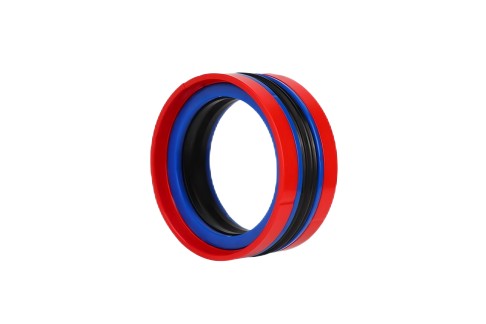
Relevant when a hydraulic piston application uses a combination-seal concept in which sealing, backup, and guidance work together. CBD SEALS lists a profile seal, backup rings, and guide rings for the KDAS construction, making it a useful example of why an extrusion or support problem should not be reduced to durometer alone.
If the required profile is not yet identified, review the wider CBD SEALS product shop only after documenting the application conditions above. Dimensions and appearance alone are not enough to confirm material, hardness, or profile suitability.
Shore A hardness and seal durometer FAQ
What does Shore A hardness tell you about a seal?
It describes resistance to standardized indentation. That helps compare relative hardness and deformation behavior, but it does not independently define pressure capability, media compatibility, friction, wear resistance, compression behavior, or service life.
Is a harder O-ring better for high pressure?
Not automatically. A harder O-ring can resist local deformation more strongly, but high-pressure sealing also depends on groove geometry, extrusion clearance, pressure direction, compound, temperature, hardware deflection, and any backup support. If the gap is excessive, hardness alone does not correct it.
How does hardness affect friction and installation?
Hardness changes how readily a seal deforms and can influence contact behavior. A harder seal may require greater assembly force or respond differently in a dynamic profile. A softer seal is more compliant but may be easier to pinch, roll, cut, or extrude. Profile, surface, lubrication, and compound remain important.
Can higher hardness solve an extrusion problem?
It may improve extrusion resistance, but first check the actual clearance, tolerance stack-up, support geometry, wear, alignment, component deflection, and pressure peaks. A backup or other support solution may address the mechanism more directly in an appropriate design.
Which application details are needed to choose durometer?
Provide the seal type or profile, hardware and groove dimensions, clearances and tolerances, pressure range, movement and speed, temperature, fluid or gas, surface condition, installation method, support components, current material if verified, and the failure mode the new selection needs to address.
Confirm material and hardness from the application—not from the Shore A number alone
If the application still needs a hardness decision, provide the seal geometry, pressure and clearance, motion, media, temperature, surfaces, installation conditions, and current failure evidence. That gives the discussion a technical basis for reviewing compound, durometer, profile, and support together.