
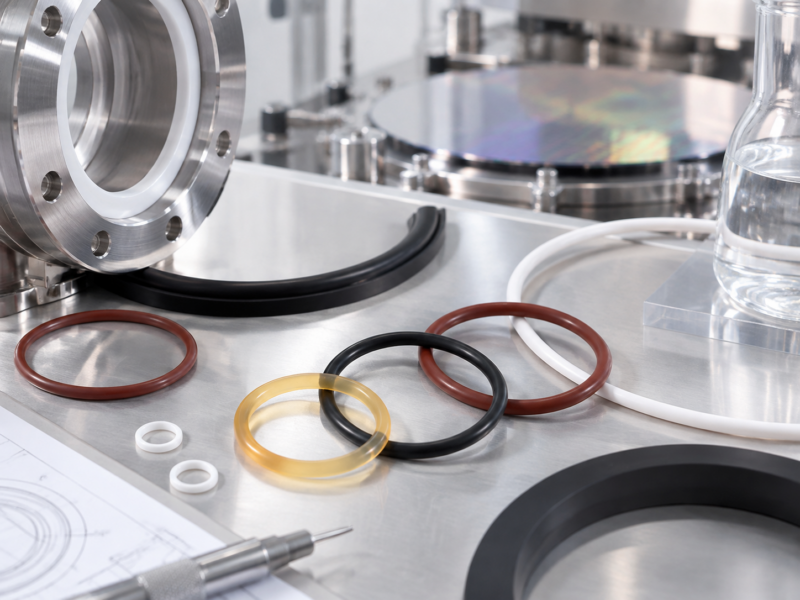
An FFKM O-ring qualification checklist helps confirm that the proposed compound and finished seal suit the actual service. Before approval, define the process media and exposure sequence, operating temperature, pressure or vacuum, seal design, cleanliness needs and acceptance criteria.
Qualification depth depends on seal location and failure consequence. A utility-side static seal may need less evidence than a process-wetted seal that could affect product purity, vacuum integrity or equipment uptime. Approve the specific compound and part—not the FFKM family in general.
Keep approval open while critical operating conditions or acceptance limits remain unknown.
Start With Seal Location and Failure Risk
Before comparing compounds, answer two questions: what does the seal contact, and what could happen if it leaks or degrades?
Map the process exposure
Identify where the seal sits and what can reach it.
- Is it process-wetted, chamber-facing or on the utility side?
- Which process, purge, cleaning or maintenance fluids can contact it?
- Is the duty static or dynamic, and does it involve pressure or vacuum cycling?
Assess the failure consequence
Use the likely outcome to set the level of review.
- Could leakage affect containment, product purity, vacuum or uptime?
- Would seal degradation be found during routine maintenance?
- Which changes to compound, source or cleaning should trigger review?
Six Checks Before Approving an FFKM O-Ring
Record each item against the proposed compound and finished part so the approval can be traced later.
Record the exact compound or supplier reference, part number and drawing revision. Link qualification samples to the intended production supply; FFKM compounds are not automatically interchangeable.
List every medium that can contact the seal, including process chemicals, gases, solvents, mixtures, cleaning fluids and relevant by-products. Include concentration, phase and exposure sequence—for example, process exposure followed by rinse, purge or hot cleaning.
Record normal and peak temperatures, exposure duration, startup or cleaning conditions, and pressure or vacuum cycles. A single maximum value may miss the sequence that drives seal stress.
Provide O-ring dimensions, gland and mating-surface details, static or dynamic duty, movement and installation constraints. A suitable compound cannot compensate for a poor gland design or installation damage.
Set cleanliness requirements by seal location. Specify the actual concern—particles, extractables, residues or outgassing—instead of relying on a broad “semiconductor grade” label.
For plasma-exposed seals, request compound-specific evidence on erosion, particle generation and metallic contamination under relevant process conditions. DuPont’s deposition-process guidance explains why results may not transfer between compounds or reactors. USP Class VI covers biological reactivity; it does not establish semiconductor cleanliness or plasma performance. See USP General Chapter <88> for its test scope.
Agree which records link production lots to the approved sample: compound identification, lot or batch traceability, conformance or inspection records, cleaning or packaging requirements, and change notification. Confirm what the supplier can provide.
How Chemical and Semiconductor Applications Differ
Both applications need compound-specific evidence, but the main qualification risks are different.
Define the full exposure
Identify the exact chemicals, concentrations or mixtures, exposure duration and cleaning sequence. Include temperature, pressure and seal movement. Labels such as “acid service” or “solvent service” are too broad for a compatibility decision.
Define the contamination boundary
Identify whether the seal faces the process or sits on the utility side. For process-facing seals, specify relevant concerns such as particles, extractables, outgassing and plasma exposure. Match handling and packaging requirements to that risk.
From Supplier Review to Production Approval
Use four stages to keep a quotation or sample from being mistaken for production approval.
Check the compound and supplier data against the specification.
Confirm the sample matches the intended production part.
Test the failure modes that matter at the seal location.
Record approval and define change triggers.
Depending on the risk, testing may cover media exposure, temperature or pressure/vacuum cycling, leakage, dimensional or volume change, hardness, mechanical-property retention, compression set or contamination. Select relevant tests and agree acceptance limits before testing.
What to Include in an FFKM O-Ring RFQ
Give the supplier enough information to assess the application before quoting.
Process and operating conditions
Seal and mechanical details
Purity and quality requirements
If a certification or test report is required, name it and ask the supplier to confirm its exact scope. Do not assume one certificate covers every cleanliness or performance requirement.
Questions to close before approval
- Does the proposed compound cover the full media and exposure sequence?
- Is the sample representative of the production compound and supply condition?
- Which test reports, quality records and lot-traceability documents can be supplied?
- Which changes to compound, source, cleaning or packaging require notification or requalification?
For general supplier quotation requirements, see the custom rubber seals RFQ guide. This article focuses on the additional checks relevant to FFKM qualification.
When FKM May Be Enough
FFKM is not an automatic upgrade for every demanding application. If the selected FKM compound meets the documented media, temperature, mechanical and cleanliness requirements, moving to FFKM may add cost without solving a defined problem.
Choose FKM when compound-specific evidence supports the actual service conditions.
Consider FFKM when FKM cannot meet a defined chemical, thermal, contamination or maintenance requirement—or when the consequences of failure justify further evaluation.
Compare the CBD SEALS Viton FKM O-rings and review the Viton O-ring chemical compatibility guide before ruling FKM out.
Compare the Relevant Seal Options
These product pages are starting points for discussion. Confirm the exact compound and application data before approval.

Solvay FFKM Perfluoroelastomer O-rings with USP Class VI
Review this option when the application points to a perfluoroelastomer. Confirm the exact compound, dimensions, media compatibility and available documentation.
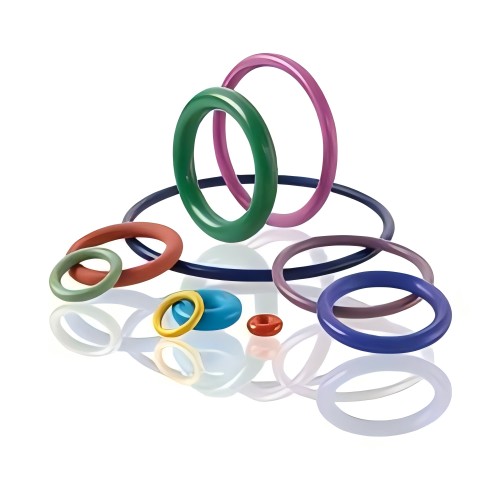
Viton FKM FPM (Fluorocarbon) O-rings
Keep FKM in the comparison when it may meet the service requirements. Suitability still depends on the specific compound and seal design.
FFKM O-Ring Qualification FAQ
Is FFKM always required for semiconductor equipment?
No. The right material depends on the seal location, process exposure and failure consequence. A process-facing seal may need different evidence from a utility-side seal.
Does USP Class VI establish semiconductor cleanliness?
No. It addresses biological reactivity within its stated test scope. It does not establish particle, outgassing, plasma or metallic-contamination performance.
Can different FFKM compounds be substituted?
Not without review. Formulations and supply conditions can differ, so assess the evidence for the actual compound and finished part before approving a substitution.
When is application testing necessary?
Test when supplier data does not cover the real exposure sequence, several stressors interact, contamination limits are critical or failure consequences are high. Set test conditions and acceptance limits first.
Approve the Evidence, Not the Material Label
A sound qualification record identifies the compound and part, the conditions reviewed, the evidence accepted and the changes that trigger reassessment. If any of these remain unclear, keep approval open.
Discuss Your FFKM O-Ring Requirements
Share the seal location, process media, operating conditions and drawing details with CBD SEALS to discuss suitable FFKM or FKM options.