
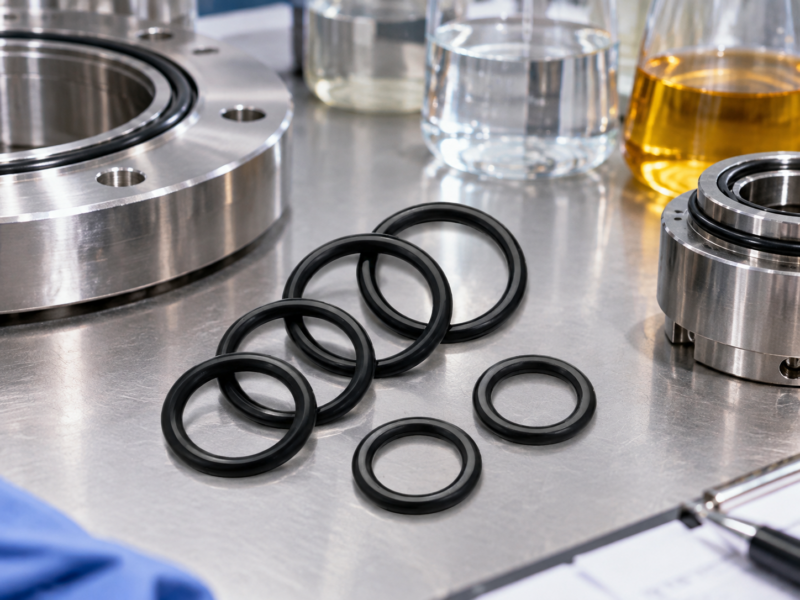
Viton O-ring chemical compatibility cannot be confirmed from the chemical name alone. Before an FKM seal is ordered, review the actual operating medium, mixture and concentration, temperature cycle, pressure, exposure time, seal motion, cleaning process and the specific compound being proposed.
FKM, sometimes identified as FPM, describes a fluorocarbon elastomer family rather than one universal formulation. A compatibility chart can narrow the material search, but it does not prove that every FKM compound will respond the same way under a particular combination of chemical exposure and operating conditions.
Why FKM Family Compatibility Does Not Approve Every Compound
A material-family name is only the beginning of the compatibility decision. Different fluorocarbon formulations can be designed around different performance priorities, so a statement that a fluid is “compatible with FKM” should not be read as confirmation that every FKM grade is interchangeable.
This distinction matters when an application is already being considered for Viton O-rings. A legacy drawing, an existing part description or a general resistance chart can identify a sensible material family, but the next step is still to compare the proposed compound with the actual operating environment.
Chemical exposure can change an elastomer through fluid absorption, extraction of compound constituents or chemical degradation. The practical result may appear as swelling, shrinkage, hardness change, loss of elasticity, cracking or a gradual reduction in sealing performance. Temperature and exposure duration can make those effects more significant.
How to Check Viton O-Ring Chemical Compatibility Before Ordering
A useful pre-order review removes uncertainty in a deliberate sequence. Start with what the O-ring contacts, then add the operating conditions that can change how the material responds.
List every medium that can reach the O-ring
Start with the normal process fluid, then include lubricants, additives, flushing liquids, cleaning agents and temporary media used during startup, shutdown or maintenance. The most demanding exposure may occur outside normal production.
Define mixtures, concentration and additives
“Oil,” “solvent,” “cleaner” or “process chemical” can be too broad for meaningful FKM O-ring chemical resistance evaluation. State whether the medium is pure, diluted or blended and provide known components or concentration ranges where possible.
Map the complete temperature cycle
Normal operating temperature is only one part of the duty. Include minimum temperature, startup, process peaks, shutdown conditions and any separate cleaning or steam stage. FKM O-ring temperature and media compatibility should be reviewed as one combined question.
Include motion, pressure and exposure time
State whether the O-ring is static or dynamic and describe the motion when relevant. Include normal and relevant maximum pressure plus exposure duration. Continuous immersion, repeated short cycles and occasional contact should not be treated as equivalent.
When FKM May Fit, When to Validate Further, and When to Compare Another Material
A useful FKM seal selection process does not force every application into an immediate yes-or-no answer. A better approach is to classify how complete the application data are and how closely the available evidence matches the proposed compound.
FKM remains a reasonable candidate
The media, concentrations, temperature cycle and exposure pattern are defined, and relevant information exists for the proposed compound or a sufficiently defined material basis.
More validation is needed
The fluid is a mixture, concentrations vary, the thermal cycle is demanding, cleaning adds another chemistry, exposure is prolonged or compound-specific information does not closely represent the application.
Compare another material family
Available evidence does not support the proposed FKM under the combined chemical and operating conditions, or the requirement lies outside the information available for the material being considered.
This framework is more useful than treating chemical resistant O-rings as a universal product category. Resistance is always relative to the specific fluid, concentration, temperature and exposure pattern.
FFKM can be considered when the chemical or thermal requirement extends beyond the available FKM evidence. That does not make it an automatic replacement. The same qualification logic still applies: define the application first, then compare the proposed material and compound with the actual service conditions.
What Chemical Compatibility Warning Signs Matter in Service?
A compatibility chart often compresses a complicated elastomer response into a simple rating. During qualification or failure review, the physical changes underneath that rating are more useful because they explain how chemical exposure may affect the seal.
When Is Additional Compatibility Validation Worthwhile?
General reference data are most useful when the application closely resembles the conditions represented by those data. Validation becomes more valuable as uncertainty increases.
Compound or supplier data
Use information tied to the material actually being considered and check whether the media and service conditions are relevant to the intended application.
Controlled immersion evaluation
Useful when an exact fluid, mixture or concentration needs closer review under defined temperature and exposure conditions.
Application-level testing
Useful when chemical exposure interacts with movement, pressure, temperature cycling, cleaning or other system variables that a simple material test does not reproduce.
Additional validation deserves particular consideration when the medium is a complex or proprietary mixture, concentrations vary significantly, elevated-temperature cleaning occurs, several fluids contact the seal sequentially, exposure is long-term, the O-ring operates dynamically or the current seal has already shown unexplained swelling, hardening, cracking or leakage.
The purpose is not to add testing automatically. It is to identify the uncertainty that could change the material decision and use an appropriate level of evidence to close that gap before release.
Questions Before Ordering Viton O-Rings: What to Put in the RFQ
A technically useful RFQ gives the supplier enough information to assess the application without guessing. It also gives engineering, procurement, maintenance and quality teams one consistent basis for reviewing the proposed material.
Move From Material Screening to the Relevant Seal Option
Once the media and operating cycle are defined, the product discussion becomes more useful. For applications already considering FKM, review the CBD SEALS Viton FKM FPM (Fluorocarbon) O-rings after the compatibility variables are known rather than selecting from the material-family name alone.
When the available FKM evidence does not match the real process closely enough, comparing another fluoroelastomer family can be more useful than forcing the original material choice. One related CBD SEALS option is shown below as an alternative to evaluate, not as an automatic substitute.

Aflas FEPM O-rings
Aflas FEPM O-rings can be worth comparing when the application involves strong bases, amines, hot water or steam, or when the available FKM evidence does not fully match the real service conditions.
It is not a default replacement for FKM. The point is to evaluate whether FEPM is a better fit for the actual media and operating cycle before the final material is approved.
Use the Whole Operating Cycle to Make the Final Compatibility Decision
The central rule for Viton O-ring chemical compatibility is to evaluate the complete exposure cycle rather than only the headline chemical. Media composition, concentration, temperature, exposure duration, cleaning chemistry, pressure, movement and the actual compound belong in the same review.
This is especially important for Viton O-rings for oils and chemicals. A broad fluid category can be useful during initial screening, but formulated oils, additives, mixed process chemicals and maintenance fluids can create a more specific service environment than the category name suggests.
A general chart can narrow the field and identify materials worth investigating. For critical applications, send the actual mixture, concentration, cleaning process and temperature cycle to the supplier. If available information does not closely represent the real application, use compound-specific data or appropriate testing before final approval.
Review the FKM Option or Send the Application for Material Evaluation
If FKM is still the leading candidate, review the fluorocarbon O-ring product page. If the correct compound is not yet clear, send the actual media mixture, concentration, temperature cycle, pressure, cleaning process and exposure conditions for discussion before ordering.
Frequently Asked Questions
Is Viton compatible with every oil or chemical?
No. FKM is considered for many oils and industrial chemicals, but suitability still depends on the exact fluid or mixture, concentration, temperature, exposure pattern and compound. A favorable family-level rating is a screening result rather than universal approval.
What media details are needed before selecting an FKM O-ring?
Provide the process medium as specifically as possible, including mixture components, concentration, additives, lubricants, cleaning agents and flushing fluids. Also state how long and how frequently the O-ring contacts each medium.
Does temperature change chemical compatibility?
Yes. Chemical exposure and temperature should be evaluated together. Include normal operating temperature, short process peaks and separate cleaning or steam cycles, especially when a different medium is present during those stages.
When should FFKM be considered instead of FKM?
FFKM may deserve evaluation when the chemical or thermal requirement is not adequately supported by the available FKM information. It should not be selected automatically; the proposed FFKM compound and the complete service conditions still need their own compatibility review.
Is a chemical compatibility chart enough to approve an O-ring?
Not always. A chart can be useful for initial screening, but it may not represent the exact compound, concentration, temperature, exposure duration, cleaning chemistry or process cycle. Critical service may justify compound-specific supplier data, controlled immersion evaluation or application testing.