
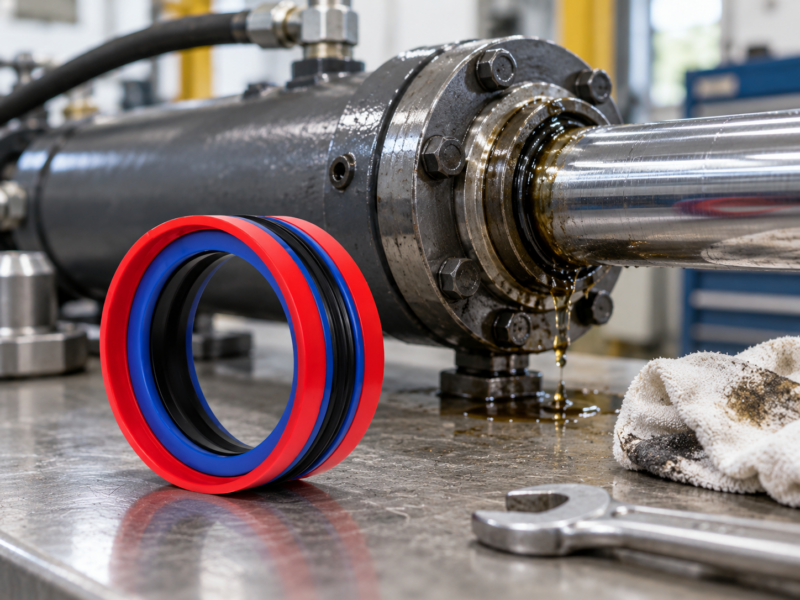
Hydraulic cylinder leakage is not automatically a seal-material problem. Effective hydraulic seal leakage diagnosis starts by separating visible external leakage, internal bypass and leakage that appears immediately after a repair. That first decision changes the inspection order. Replacing the same seal again can temporarily hide a damaged rod, scored bore, side load, contamination source, excessive clearance or pressure event while leaving the real failure mechanism in place.
Before removing the cylinder, capture what the machine is doing while the symptom is still repeatable and while it is safe to observe. Record the leak location, direction of motion, pressure and temperature behavior, contamination evidence and recent repair history. Then inspect the seal together with the running surfaces, guides, alignment and operating conditions that allow the entire hydraulic sealing system to work.
Diagnose the leakage path before choosing the replacement.
Start with leak type and timing, then work through installation, surfaces, alignment, contamination, clearance, pressure transients and duty conditions. A damaged seal is evidence; it is not automatically the root cause.
First separate external leakage, internal bypass and an immediate post-repair leak
The visible symptom determines where to look first. Oil around the rod or gland points to an external sealing path, but that does not prove the rod seal material is wrong. Rod scoring, gland alignment, guide wear, pressure behavior and contamination can all create or accelerate the same visible leak. By contrast, a cylinder that drifts or loses holding ability without external oil may be experiencing internal bypass. A leak that begins on the first few cycles after service makes installation damage, incorrect assembly and damaged mating surfaces much higher priorities.
Visible outside
External leakage
Fluid appears at the rod, gland, port area or another external interface. Clean the area and identify the first wet point before oil spreads and hides the origin.
No obvious external oil
Internal bypass
Drift, slow response or reduced holding performance can indicate leakage across the piston area, but valve or circuit leakage can create similar behavior.
Right after service
Immediate leakage
Prioritize installation damage, incorrect orientation, trapped debris, burrs and running-surface damage before changing material or hardness.
Separating internal bypass vs seal leakage prevents unnecessary component changes. When performance suggests internal leakage, isolate the cylinder from the rest of the circuit using the equipment manufacturer’s approved procedure before blaming the piston seal. Once the failure mode is reasonably clear, the hydraulic seals category becomes a useful reference for replacement options rather than a substitute for diagnosis.
Risk reminder: never use a hand or bare skin to search for a pressurized pinhole leak. High-pressure fluid can penetrate skin. Observe from a safe position and fully isolate and depressurize the system before disassembly.
Record what the cylinder is doing before the evidence disappears
A removed seal can show cuts, extrusion or abrasion, but it cannot reconstruct the operating sequence that produced them. This is why the answer to why hydraulic seals leak after replacement often starts with observations made before the next teardown rather than with the old seal in a parts tray.
- Leak location: rod end, gland, port area, body joint, or no visible external leak.
- Direction and timing: extension, retraction, holding, startup, stopping, warm-up or only under load.
- Pressure behavior: normal operating readings, known spikes, abrupt stops, shock events or symptoms linked to load changes.
- Temperature behavior: whether leakage changes after prolonged cycling, cold start or full operating temperature.
- Contamination evidence: dirt on the rod, damaged wiper area, particles, dirty fluid or a recent contamination event.
- Recent maintenance: new seals, rod work, cylinder rebuild, guide replacement, valve changes, mounting work or machine impact.
Also record sticking, chatter, uneven motion, abnormal heat and visible rod deflection. Those details can connect hydraulic cylinder seal leakage to a mechanical condition that may disappear once the cylinder is removed from the machine. If the troubleshooting context extends beyond the cylinder itself, CBD SEALS’ verified fluid power sealing solutions page provides the broader system context for dynamic seals, rods, pistons and other fluid-power interfaces.
Seven hydraulic seal failure causes to check beyond the seal itself
The fastest investigation usually starts with conditions that can damage a new seal immediately, then moves outward to surfaces, alignment, contamination, mechanical support and operating conditions. For each cause, look for physical evidence, perform one verifying check and avoid the common repair that only resets the symptom.
1
Installation damage
A new seal can be cut, twisted, rolled or nicked before the cylinder completes its first working cycle. Threads, ports, burrs, sharp groove edges and improvised tools can damage a lip during assembly. Incorrect orientation or installation in the wrong groove can produce immediate leakage even when the replacement part itself is correct.
2
Rod or bore surface damage
Dynamic seals work against a moving surface. Scoring, corrosion, pitting, dents or localized damage can open a leakage path or repeatedly abrade the sealing edge. That makes rod condition central to diagnosing external hydraulic cylinder leakage causes. Bore condition matters for piston seals for the same reason.
Surface finish should be treated as a functional condition, not only a cosmetic one. An unevenly refinished or damaged running surface can change lubrication and wear behavior. Inspect the full working travel, not only the short portion visible with the cylinder parked.
3
Misalignment, eccentricity and side load
Hydraulic seal leakage from misalignment often produces uneven wear instead of a uniform loss of sealing. A bent rod, worn guidance, mounting error or machine side load can force the rod or piston toward one side of the available clearance. Contact pressure rises on one side while support falls on the other.
Look beyond the seal groove. Pins, clevises, machine linkages and cylinder mounts can introduce forces that the seal was never intended to carry. One-sided polishing, asymmetric guide wear or recurring damage at the same circumferential position are useful clues.
4
Contamination entering or circulating through the system
Contamination attacks from both directions. Dirt carried along the rod challenges the wiper and can migrate toward the rod-seal area. Particles already in the hydraulic fluid can travel through the cylinder and create abrasive tracks, lip damage and scoring on the mating surfaces.
A repeat failure after overhaul deserves special attention to cleaning practice. Debris left in a groove, on a tool or inside a component can damage a replacement before normal filtration has any chance to remove it.
5
Abnormal clearance, worn guides or support components
A seal works inside a mechanical envelope. As bearings, wear rings, glands, piston guidance or other support components wear, clearances and component position can change. Under pressure, the seal may then be forced toward an unsupported gap, producing localized extrusion or nibbling.
This step is especially important in cylinder leakage troubleshooting when the same failure returns after more than one seal change. If the hardware no longer controls rod or piston position, replacing the flexible sealing element does not restore the original geometry.
6
Pressure spikes and transient hydraulic loads
A steady gauge reading can miss the event that actually damages the seal. Rapid valve action, sudden load changes, end-of-stroke events and abrupt machine movements can create short transients that are not obvious during routine inspection. A sealing arrangement that survives stable operation can still be damaged by repeated pressure shocks.
Pressure can also build where a space is expected to drain or vent. Restricted return paths, trapped pressure or blocked venting can change the load on a seal. Diagnosis should therefore consider the pressure acting around the whole sealing arrangement, not only the nominal supply value.
7
Operating conditions or seal selection no longer match the duty
Material and profile selection still matter, but they should be reviewed after mechanical causes are understood. Fluid, temperature, movement, pressure cycle, duty cycle and environmental exposure all affect sealing behavior. A machine that has changed fluid, cycle rate, operating load or process temperature may no longer be reproducing the conditions in which the previous arrangement worked.
The same caution applies when a replacement is selected from dimensions alone. Matching diameter and section does not confirm compatibility with the fluid, friction behavior or actual duty. Document the real application first, then compare seal options from that evidence.
Read the failed seal as evidence.
Damage pattern, rod condition, bore condition, guide wear, contamination marks, pressure history and failure timing should tell the same story. If they do not, the root cause has probably not been isolated yet.
Use leakage timing to decide what to inspect first
Leak timing is a practical shortcut when deciding how to diagnose hydraulic cylinder leaks. Instead of giving every possible cause equal priority, start with the conditions that best fit when the symptom appeared.
Know when to inspect piston seals, wiper seals and the complete sealing system
Not every leakage symptom points to the same component. The cylinder should be treated as a system in which pressure seals, wiping elements, guide components, running surfaces and mechanical support interact. Choosing the correct inspection target is more useful than automatically replacing the most visible seal.
Piston seals
Give the piston sealing area more attention when the cylinder drifts, loses holding ability or performs poorly without matching external oil loss. Circuit leakage still has to be separated from true cylinder bypass.
Wiper seals
Inspect the wiper closely when dirt, water or debris is carried toward the gland or when contamination marks appear downstream. The wiper controls external contaminant entry; it should not be treated as the main pressure seal.
Complete system
Inspect the full arrangement after repeat failures, one-sided wear, guide damage, changed duty conditions or evidence that several components were affected by the same mechanical cause.
The useful purchasing question is not simply “Which seal fits this diameter?” It is “Which seal arrangement fits this diagnosed application after the rod, bore, guidance, clearance and operating conditions are verified?” That distinction helps prevent the next replacement from entering the same failure environment.
Record the evidence before ordering replacement hydraulic seals
A profile, old part number or rough dimension can help identify a physical component, but it does not explain why the previous seal leaked. Good purchasing information combines part identification with the evidence collected during troubleshooting.
- Cylinder or machine identification and application
- External leakage, internal bypass or both
- Exact leak location and direction of motion
- When the symptom began relative to the last repair
- Existing seal profile, dimensions and orientation where known
- Groove condition and relevant measured dimensions
- Rod and bore condition, including scoring or corrosion
- Condition of guides, wear elements and wiper components
- Hydraulic fluid and any recent fluid change
- Observed pressure behavior and known shock events
- Temperature behavior, stroke and duty pattern
- Clear photos of the failed seal and surrounding hardware before cleaning
Buyer recommendation: identify the system cause and inspect the mating surfaces before ordering replacements. Do not use a harder material simply to conceal misalignment, damaged hardware, abnormal clearance or pressure behavior.
Keep failed parts until the investigation is complete. Their cut edges, extrusion pattern, embedded debris and uneven wear may be the only direct evidence connecting the leak to installation, contamination, alignment or pressure conditions.
Review product options only after the root cause has been narrowed down
Product selection should come after the cylinder has been inspected and the leakage mechanism is understood. CBD SEALS lists several hydraulic and pneumatic seal families; for this article, only a directly relevant piston-seal product is shown rather than adding unrelated products for quantity.

Relevant when diagnosis points toward the piston sealing area and the existing cylinder uses a compatible combination-seal arrangement. CBD SEALS describes KDAS as a piston combination seal that integrates sealing and guidance elements in a compact assembly.
Use the product page to continue the decision, not restart it
- If the leak is external at the rod, do not choose a piston seal simply because the cylinder is losing oil.
- If drift is present, isolate the cylinder from valve or circuit leakage before attributing the symptom to the piston seal.
- If the bore is scored or guidance is worn, correct the mechanical condition before expecting a new seal to solve the problem.
- If the existing seal profile cannot be positively identified, record the groove, dimensions and operating conditions before requesting an alternative.
For a broader comparison after diagnosis, use the CBD SEALS product shop or the hydraulic and pneumatic seal category rather than forcing a profile match from appearance alone.
Hydraulic cylinder leakage troubleshooting FAQ
Why does a hydraulic cylinder leak after seal replacement?
An immediate repeat leak can come from installation damage, incorrect orientation, contamination, a damaged rod or bore, misalignment, excessive clearance or an incorrect replacement choice. Inspect the failed seal and the mating surfaces before installing the same part again.
How can internal leakage be separated from external leakage?
External leakage produces visible fluid outside the cylinder. Internal leakage may show up as drift, reduced holding force or poor performance without visible oil loss. Because valves and other circuit components can create similar symptoms, isolate the cylinder using the manufacturer’s approved diagnostic procedure before blaming a piston seal.
Can rod damage cause a new seal to fail?
Yes. Scratches, corrosion, pits or dents in the rod’s working area can cut or abrade a new sealing lip. Inspect the complete section of rod that passes through the seal, not only the portion visible at rest.
How does contamination affect hydraulic seals?
External debris can move past a damaged wiper toward the rod-seal area, while particles in the fluid can abrade seals and running surfaces from inside the cylinder. Contamination can therefore damage the seal directly and also create the surface damage that causes later leakage.
What should be recorded before ordering replacement seals?
Record the seal location and profile, relevant dimensions, leak type, rod and bore condition, guide and wiper condition, fluid, pressure behavior, temperature, duty cycle, contamination evidence, recent repairs and photos of failed components. Include machine or cylinder identification when available.
Move from diagnosis to the correct replacement path
A useful hydraulic seal leakage diagnosis should explain where the fluid crossed the sealing boundary, what condition allowed it to happen and what must be corrected before the cylinder returns to service. Once that evidence is recorded, compare the relevant seal range or send the application details for technical discussion.