
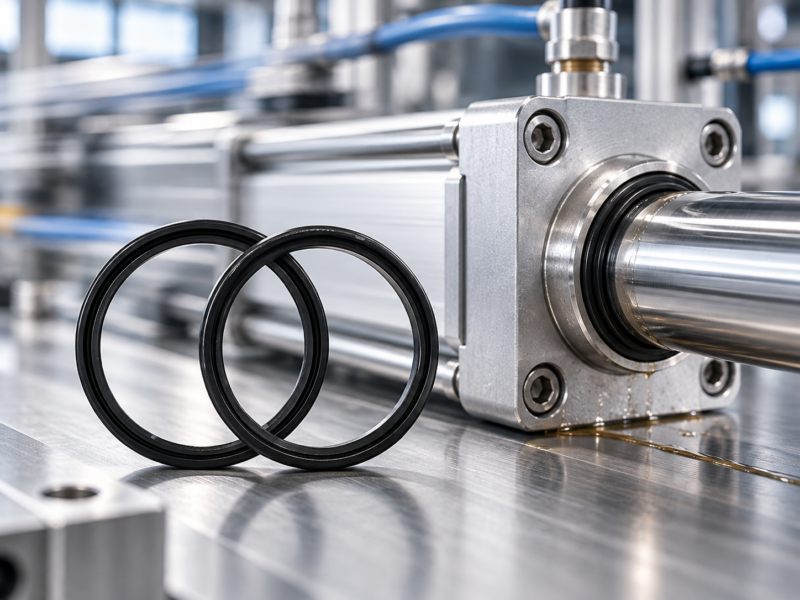
Effective pneumatic seal selection for low-friction cylinders is about more than finding a seal with light contact. The cylinder still needs to start at the available pressure, travel smoothly across its working speed range and maintain adequate sealing through repeated cycles. A seal that feels easy to move on the bench can be a poor choice if it leaks in service or sticks after a long stop.
That is why speed, pressure and lubrication need to be evaluated together. They shape the friction at the sealing interface, while surface condition, alignment and the cylinder’s duty cycle often determine whether that friction becomes an operating problem.
The key distinction: The goal is not the lowest possible friction at any cost. It is predictable motion with acceptable leakage and wear across the cylinder’s real operating conditions.
Why low friction means different things at different points in a cylinder stroke
A cylinder that starts reluctantly and then runs smoothly has a different problem from one that jerks during a slow approach. Both may be described as having too much friction, but choosing a seal based on one friction value is unlikely to resolve both. First identify when the unwanted behavior occurs.
Breakaway friction
The resistance to the first movement after a stop. It matters when available starting pressure is low, or when the cylinder must restart after a long dwell.
Running friction
The resistance during travel. It affects usable output force and may influence heat generation, wear and consistency over repeated strokes.
Stick-slip
Irregular movement as the actuator alternates between sticking and releasing, often most noticeable during slow, controlled motion.
Seal geometry and contact preload influence all three, but the seal is not the only source of resistance. Guide friction, side loading, poor alignment, valve response and changing pressure can produce similar symptoms. For low-speed positioning, the transition from static to dynamic friction may matter more than the lowest possible running-friction number.
Increasing seal contact can help control leakage while raising mechanical resistance; reducing it can have the opposite effect. This is the trade-off to establish before comparing materials or profiles. CBD SEALS’ pneumatic seal range is a useful product starting point once the operating requirement is defined, rather than a substitute for that definition.
How speed, pressure and the cylinder’s operating conditions affect seal choice
Start by identifying where the seal works. A piston seal controls leakage between cylinder chambers; a rod seal limits leakage along the rod; and a wiper helps keep contamination out. Similar-looking seals are not necessarily interchangeable across these positions.
Speed and available pressure belong in the same discussion
Maximum travel speed is only part of the story. A cylinder can cycle quickly for most of the stroke but approach its end position slowly, reverse sharply or restart at a much lower pressure than it uses during normal travel. Record the lowest controlled speed, the repeated working speed and the maximum speed, together with acceleration and reversal conditions.
Pressure determines the force available to overcome seal friction and the rest of the mechanism’s resistance. The minimum differential pressure required for startup may therefore be more revealing than nominal supply pressure, particularly for lightly loaded or low-pressure cylinders.
Surface condition, alignment and the duty cycle can change the result
Surface finish, wear, scoring and corrosion affect the contact between a seal and its mating surface. Dwell time, stroke length, cushioning and reversal frequency further influence what the interface experiences. A seal that performs well in continuous cycling may behave differently on the first movement after several hours at rest.
Air quality also belongs in the specification: filtration, moisture and contamination can influence the long-term condition of the seal and cylinder. If the issue involves guidance or the actuator beyond the sealing interface, the CBD SEALS Fluid Power System page provides wider system context.
For a useful comparison, describe the most difficult point in the cycle—not only the normal operating point. That may be a slow final approach, a low-pressure start or the first stroke after a long dwell.
Lubrication changes the friction picture—but the regime must be clear
Pneumatic seal lubrication influences how the sealing interface behaves during startup and repeated motion. Simply describing a cylinder as “lubricated” leaves an important question unanswered: is lubricant supplied continuously, left from assembly, or absent in normal service?
| Continuous lubrication | Lubricant is intentionally supplied during operation. Verify how it reaches the cylinder, whether supply is consistent, and whether the selected seal is compatible with the lubricant. |
|---|---|
| Limited lubrication | An initial grease or lubricant film may remain for some time without continuous replenishment. Startup after dwell and behavior after repeated cycles may not match initial bench testing. |
| Dry running | No added operating lubrication is expected. Review the proposed profile and compound against speed, mating surface, contamination, leakage and wear requirements; do not assume a material label proves suitability. |
For dry-running pneumatic cylinder seals, the condition of the mating surface and the real duty cycle become especially important. For a lubricated system, maintenance practice matters too: changing a grease or removing oil from an air line can alter the interface even when the seal has not changed.
Terms such as “low friction” and “self-lubricating” are useful descriptions only when supported by the specific product’s operating limits. Profile shape, preload, pressure and surface condition still need to be assessed together.
The best seal priority depends on how the cylinder is used
Two cylinders with the same bore and nominal pressure may need different sealing decisions. The critical condition is often defined by the machine’s motion rather than the cylinder dimensions alone.
For precise, low-speed positioning
Movement consistency usually matters more than achieving the lowest average drag. If the cylinder hesitates and then jumps ahead, investigate the transition between breakaway and running friction, but also check alignment, side load, valve behavior and pressure stability before blaming the seal.
For fast, repetitive strokes
Repeated motion brings running friction, surface condition and wear into sharper focus. The stroke includes acceleration, reversal and cushioning, so a performance check at one constant velocity is not enough. Lubrication availability throughout the cycle can be as important as the initial friction result.
For low-pressure startup
Any breakaway resistance consumes a larger proportion of the available force. Specify the minimum differential pressure at which the cylinder must move, together with its external load and acceptable leakage. Simply reducing seal contact may make starting easier while compromising the sealing margin.
For equipment that sits idle
A long dwell can make the first movement different from the strokes that follow. Where machinery spends much of its time on standby, representative restart behavior should form part of the review instead of relying only on data from a warmed-up, continuously cycling cylinder.
What cylinder behavior can tell you about the friction–leakage trade-off
When a seal selection is causing difficulty, the symptom is often more useful than another material comparison. For example, a cylinder that starts late but then moves normally calls for an investigation of breakaway conditions. Lower preload might help, but not if the resistance is mainly coming from a guide or side load.
If the cylinder moves freely but air leakage rises, the priority changes. Check where the leakage occurs, then review the seal geometry, contact, surface quality and pressure condition. Easy motion does not represent a successful low-friction design if the cylinder can no longer satisfy its air-consumption or holding requirements.
At very low speed, jerking or chatter calls for a broader motion-system review. Seal friction may be involved, but pressure control, valve response and mechanical guidance can create the same visible behavior. Early wear during high-speed cycling points instead toward mating surfaces, contamination, lubrication and reversal or cushioning conditions.
Judge motion and sealing together. A useful acceptance check considers starting pressure, stable low-speed travel and leakage after representative cycles and dwell—not only the first successful bench stroke.
Where low-friction seal selection most often goes wrong
One common mistake is optimizing for minimum friction without first deciding how much leakage the cylinder can tolerate. Another is using a strong running-friction result to assume good startup performance. A cylinder that sits idle for long periods can fail the real requirement even when it performs well once moving.
Maximum speed alone can also mislead. The critical event may be a slow approach, pressure change or reversal. Likewise, lubrication should not be treated as permanent if the system uses assembly grease or if maintenance practices may change over time.
Finally, hydraulic-seal experience does not transfer automatically to an air cylinder. The working medium and lubrication environment differ. Material family and Shore hardness are useful inputs, but neither establishes the complete behavior of a pneumatic seal without its profile, surface and duty conditions.
What to share with a supplier before comparing pneumatic seals
A sample seal or a nominal dimension can help identify a profile, but it cannot explain why a cylinder has poor starting response, unstable movement or premature wear. A more useful enquiry connects the part to the motion requirement and the operating environment.
Provide the bore or rod dimensions and groove information alongside the seal location. Then add the pressures at startup and during operation; minimum and maximum working speeds; stroke, reversal and dwell pattern; load and alignment concerns; and the actual lubrication regime. Surface condition, compressed-air quality, temperature, and any observed leakage or friction symptoms help narrow the discussion further.
This allows a supplier to discuss whether an existing profile is a reasonable candidate, which assumptions still need validation and what testing should accompany a replacement. It is considerably more informative than requesting the “lowest-friction material” without specifying where the cylinder must perform.
Explore MYA Pneumatic Seals for an application-specific review
Once the operating conditions are clear, it makes sense to compare actual products. CBD SEALS lists MYA Pneumatic Seals for reciprocating pneumatic piston sealing, including uses in small cylinders or valves. Whether the profile is suitable for a particular low-friction duty depends on the cylinder geometry, leakage target and service conditions—not on the product name alone.

MYA Pneumatic Seals
If you are selecting a piston seal for a small pneumatic cylinder or reviewing an existing MYA-type profile, the product page is a sensible place to check geometry and request application-specific details. Compare the candidate against your actual starting pressure, speed range, lubrication and surface condition, rather than assuming it is suitable for every low-friction application.
For other geometries or duties, the wider hydraulic and pneumatic seal range provides a broader starting point.
Frequently asked questions about low-friction pneumatic seals
What causes high breakaway friction in a pneumatic cylinder?
Possible contributors include seal preload and geometry, lubrication at startup, dwell time, mating-surface condition, guide friction, alignment and external loading. If the cylinder moves normally after starting, investigate the complete startup force balance.
How do speed and pressure affect pneumatic seal selection?
Pressure affects the force available to overcome resistance, while speed changes the dynamic conditions at the sealing interface. Consider the minimum controlled speed, maximum repeated speed, starting pressure and reversal behavior rather than a single nominal point.
Can pneumatic seals work without added lubrication?
Some sealing arrangements are designed for operation without continuous added lubrication, but suitability must be confirmed for the specific profile and service conditions, including surface finish, speed, leakage and wear requirements.
What causes stick-slip in an air cylinder?
Stick-slip involves repeated sticking and releasing during movement. Seal contact may contribute, but valve behavior, pressure stability, misalignment, side load and guide friction can also produce or worsen the symptom.
What information should I provide when requesting a pneumatic seal?
Share the seal position, dimensions and groove geometry, operating and startup pressures, working speed range, stroke and dwell pattern, lubrication regime, surface condition, air quality and any current leakage, friction or wear symptoms.
Find a seal that fits the way your cylinder actually works
For pneumatic seal selection for low-friction cylinders, an operating description is more useful than a low-friction label alone. If you have a cylinder drawing and can describe its speed, startup pressure, lubrication and leakage requirements, CBD SEALS can review the relevant product options in context.