
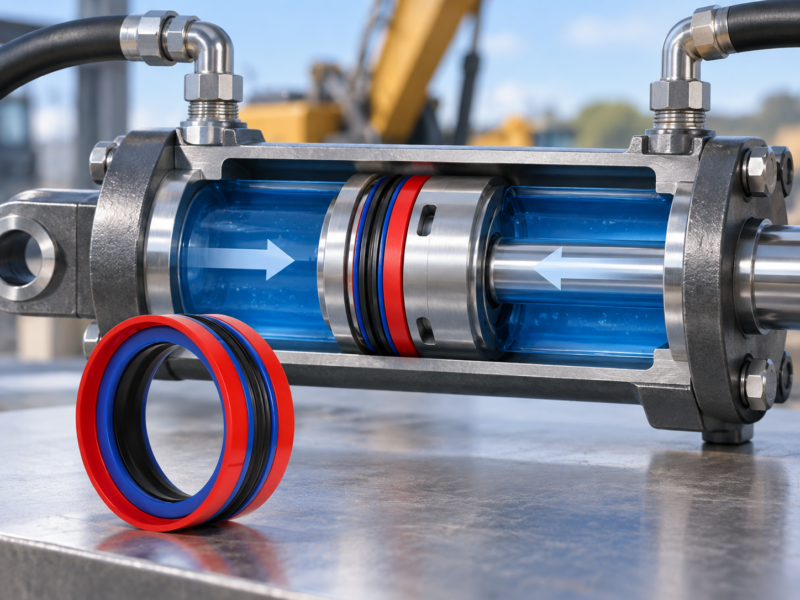
Selecting piston seals for double-acting hydraulic cylinders starts with the way pressure acts on both sides of the piston, not with seal diameter alone. Confirm the cylinder structure and bidirectional pressure first, then work through the pressure cycle, extension and retraction speed, friction target, cylinder-bore condition, extrusion gap, installation groove, guidance, hydraulic fluid and operating temperature.
For a repair, the removed seal is useful evidence, but copying its dimensions can repeat the same failure if the previous profile was unsuitable or the bore, guide elements or clearances have changed. For a new design, the sealing profile, groove and piston guidance should be considered as one system. The practical question is not simply “Which seal fits this bore?” but “Which sealing arrangement fits the way this cylinder actually operates?”
Start with pressure direction and cylinder geometry, then narrow the seal choice by speed, friction, clearance, guidance and operating medium.
A double-acting piston must control internal leakage during extension, retraction and repeated pressure reversal. A seal can fit the groove and still be the wrong choice if its pressure behavior, friction response or support requirements do not match the cylinder.
Do not copy the old seal by size: follow the cylinder’s operating logic
A double-acting cylinder changes the pressure side as the piston changes direction. That makes seal selection a chain of connected decisions rather than a diameter lookup. Pressure determines how the sealing element is loaded. Geometry determines whether it is adequately supported. Motion affects friction and lubrication. Guidance determines whether the piston stays centered. The medium and temperature then narrow the material choices that can be reviewed for the application.
Once these inputs are defined, CBD SEALS’ piston seals and broader hydraulic sealing range can be reviewed against a real cylinder condition rather than used as a substitute for application data.
Repair rule: if the previous piston seal shows abnormal or one-sided wear, inspect the bore, piston guidance and extrusion clearance before reordering the same profile. A replacement seal cannot correct a worn guide ring, damaged bore or excessive running clearance.
Pressure direction comes before piston seal profile
A double-acting hydraulic cylinder uses fluid pressure to drive the piston in both directions. During one part of the cycle pressure acts on one piston face; after reversal, the opposite chamber becomes the pressure side. This is why piston seal pressure direction should be established before comparing profiles or materials.
The selected bidirectional piston seal or complete sealing arrangement must control leakage when pressure transfers from one chamber to the other. Groove orientation, seal architecture and support therefore need to be understood before a size is ordered.
Pressure direction should also be separated from the pressure cycle. Two cylinders may have similar normal working pressure yet create different sealing demands because one reverses frequently, one spends long periods holding load, or one experiences abrupt load changes. Record what the cylinder is doing when pressure rises, falls or changes sides.
Do not assume that installing two seals automatically creates a better double-acting arrangement. Multiple sealing elements introduce their own orientation, trapped-pressure and installation considerations. If an existing piston uses more than one seal, document the original spacing and direction before modifying the layout.
The useful handoff to a seal supplier is therefore not just “maximum pressure.” It is a description of normal pressure, which side is pressurized at each part of the stroke, whether the cylinder holds load, how often direction reverses and whether unusual shock events are known. That information gives pressure direction a practical meaning instead of reducing the selection to a single number.
Select by speed and friction together, not by maximum speed alone
Piston seal selection by speed and pressure works only when those values are connected to the cylinder’s real motion. Maximum speed does not describe how the cylinder starts, reverses, creeps, pauses or holds position. Those details matter because friction and lubrication behavior influence smoothness, heat generation and wear.
Watch breakaway behavior
A cylinder that must move smoothly at very low velocity can expose friction, lubrication or alignment problems that are less obvious during faster travel. If crawling appears, inspect the seal together with bore condition and piston guidance.
Consider repeated dynamic contact
Continuous extension and retraction make running friction, surface condition and stable guidance more important. Record the real duty pattern rather than describing the application only as “fast” or “slow.”
Balance motion with leakage control
A cylinder may need low running friction while still controlling internal leakage during pauses and reversals. State those requirements together instead of treating them as separate purchasing questions.
Friction targets should be tied to the machine’s behavior. For a positioning cylinder, smooth low-speed movement may matter more than minimizing drag at every point in the stroke. For a repair cylinder with no motion-quality complaint, changing to a dramatically different friction behavior without understanding the original system can create a new issue.
If low-speed crawling appears after a seal change, do not immediately conclude that the new seal material is unsuitable. Recheck installation, lubrication conditions, cylinder-bore surface finish, guide alignment and side load. A seal can reveal an existing mechanical problem rather than being its only cause.
Useful question for engineering and maintenance teams: “What must the cylinder feel like in motion?” Smooth creeping, rapid cycling, precise positioning and occasional actuation are different operating objectives even when nominal pressure and bore diameter are identical.
Read the bore, extrusion gap, groove and guidance as one geometry system
Cylinder piston sealing depends on more than nominal cylinder bore. The seal works against a real running surface and inside a real clearance envelope. Wear, bore damage, piston movement and guide condition can change that environment long after the cylinder was first assembled.
Inspect the working stroke for scoring, corrosion, localized wear or other damage. Do not judge the full bore from the easiest area to see.
Determine the relevant piston-to-bore clearance and whether wear or piston movement increases the unsupported gap seen by the seal.
Measure groove dimensions and access. Review lead-in surfaces, burrs and assembly edges that could damage the seal before service begins.
Inspect wear rings or guide rings for uneven wear and evidence of side loading. Their condition directly affects piston alignment.
These factors interact. Worn guide elements can let the piston move off-center. That increases the local extrusion gap on one side while increasing contact on the other. The resulting edge damage may appear to be a piston seal problem even though the initiating condition is poor guidance.
Surface condition matters for the same reason. A scored, corroded or unevenly repaired bore can alter sealing contact and lubrication. If a replacement seal develops damage at the same point in the stroke, compare the seal marks with the corresponding area of the cylinder bore rather than changing profile immediately.
The groove should be measured rather than inferred from the old seal. A used elastomeric or polymer sealing element can be worn, permanently deformed or damaged during removal. Groove width, depth, edge condition and installation access provide better evidence of what can be fitted safely.
Installation space also determines what profiles are practical. Some seals can tolerate more deformation during assembly than others; some multi-component arrangements need room for several elements. A theoretically attractive profile is not a practical choice if the piston geometry forces damaging installation.
Compare double-acting piston seals by function, not by product name
Once pressure direction, motion and geometry are understood, compare seal profiles according to what they need to do inside the cylinder. This keeps the selection focused on function rather than turning the article into a product catalog.
No profile family is automatically preferable in every double-acting cylinder. The better comparison is whether the profile’s pressure behavior, friction characteristics, support needs and installation method match the actual cylinder.
This is also where material review belongs. Fluid and operating temperature can eliminate material options, but material alone does not solve a pressure-direction error, damaged bore, excessive extrusion gap or worn guide system. Mechanical fit and operating duty should be established first so the material choice is being made for the right seal architecture.
Map low-speed crawling, internal leakage, wear and assembly problems back to the selection
Failure symptoms can shorten the decision process because they show which assumptions need to be rechecked. This is especially important when piston seal wear in double-acting cylinders returns after a recent repair.
A failed seal is evidence, not automatically the root cause. The damage pattern, bore condition, guide wear, groove condition and operating history should support the same explanation. If they do not, another replacement may simply reset the symptom.
Avoid a common repair shortcut: do not move to a “harder” or more aggressive seal choice simply to mask misalignment, excessive clearance or a damaged running surface. Correct the mechanical condition first, then select the sealing arrangement for the verified geometry.
Treat the piston seal and wear or guide elements as one system
Three functions, one piston assembly
The piston seal controls fluid bypass. Guide or wear elements support alignment and lateral loading. The cylinder bore forms the running surface and part of the clearance envelope in which both functions have to work.
Why guidance changes seal behavior
When guidance wears, piston position can shift inside the bore. Local clearance can increase on one side while contact pressure rises on the other, creating asymmetric seal wear or extrusion damage.
During repair, inspect guide elements whenever the piston seal shows one-sided damage. During design, reserve enough installation space for both sealing and guidance instead of treating the seal groove as an isolated feature.
This system view also explains why changing only the seal profile does not always solve recurring leakage. Bore condition, guidance and operating clearance create the mechanical environment in which the seal has to work. CBD SEALS’ fluid power sealing solutions page provides broader context for how piston, rod, guiding and other sealing interfaces relate within a hydraulic system.
Collect the complete cylinder data before ordering
The answer to how to choose piston seals for a double-acting cylinder becomes much more reliable when the selection request includes real geometry and actual operating conditions. An old part number, a nominal bore or a worn seal sample can help with identification, but each leaves important questions unanswered.
- Cylinder bore diameter and piston diameter
- Seal-groove diameter, width and depth
- Accessible installation path and groove edge condition
- Existing seal profile, arrangement and orientation where known
- Wear-ring or guide-ring dimensions, position and observed condition
- Measured or calculated piston-to-bore clearance relevant to extrusion
- Bore surface condition across the working stroke
- Working pressure on both piston sides
- Pressure reversals, holding periods and known shock events
- Extension and retraction speed
- Any low-speed positioning or smooth-creep requirement
- Hydraulic fluid or other operating medium
- Operating temperature conditions
- Photos or drawings of the piston, groove and failed seal when troubleshooting
For OEM work, drawings and application data usually create a clearer selection path than a request based on bore size alone. For maintenance work, measure the hardware after disassembly when wear is suspected instead of assuming the original geometry is still present.
If the removed seal has abnormal wear, preserve it until the investigation is complete. Edge damage, extrusion marks, localized polishing or embedded contamination can help connect the seal failure to the cylinder condition. Cleaning or discarding the part too early can remove useful evidence.
Buyer recommendation: select from the complete cylinder duty and groove geometry. If the old seal shows abnormal wear, inspect guidance, clearance and running surfaces at the same time rather than upgrading the seal in isolation.
Review a relevant piston seal only after the cylinder data is defined
Once the cylinder data is clear, a product page becomes a useful comparison tool rather than the starting point. That makes it easier to judge whether a seal matches the cylinder’s groove, operating duty and overall arrangement instead of choosing by appearance alone.

CBD SEALS presents KDAS as a compact multi-component piston sealing set that combines the sealing element with support and guide-related parts. It is most relevant when the existing piston has been designed around this type of integrated sealing-and-guidance arrangement.
OK Piston Seals
CBD SEALS positions the OK profile for double-acting piston applications, so it becomes a sensible comparison point when bidirectional pressure is the main requirement. In practice, its value lies in helping buyers compare profile logic against the cylinder they are working with.
That still should not be read as automatic application approval. Before moving forward, confirm the piston groove, bore and clearance, operating medium, pressure cycle, speed, friction requirement and installation method.
- Use the product page to verify the available geometry against the actual piston.
- Compare the profile only after abnormal bore or guide wear has been ruled out.
- If the old seal cannot be positively identified, provide groove measurements and cylinder drawings rather than matching appearance.
If you need to compare beyond these two examples, the hydraulic piston seal category page is most useful after the application data above has been gathered.
Frequently asked questions
What makes a piston seal suitable for a double-acting cylinder?
The sealing arrangement must control pressure as the loaded side of the piston changes between extension and retraction. Groove geometry, clearance, speed, friction requirements, guidance, bore condition, operating medium and temperature also need to match the application.
How does pressure direction affect piston seal selection?
Pressure direction determines how a seal is loaded and energized. Because a double-acting cylinder reverses that load, the seal or complete sealing arrangement should be selected for bidirectional pressure rather than assuming one permanent pressure side.
What causes internal leakage past a piston seal?
Possible causes include seal wear or damage, an unsuitable pressure-direction arrangement, bore scoring, excessive clearance, groove problems, contamination and worn guidance that changes piston alignment. Where relevant, circuit leakage should be separated from true cylinder bypass.
How do speed and friction affect seal choice?
Speed changes the dynamic contact and lubrication conditions, while friction affects breakaway force and movement smoothness. Very slow positioning can be especially sensitive to friction, bore condition and alignment, so maximum speed alone is not enough for selection.
Which cylinder dimensions are needed before ordering?
Record the cylinder bore, piston diameter and complete seal-groove dimensions. Where guidance or extrusion clearance is important, also include the wear-ring arrangement and relevant piston-to-bore clearance together with the actual operating conditions.
Match the seal to the complete cylinder, not just the bore diameter
A sound selection starts with pressure direction and follows through pressure cycling, speed, friction, bore condition, extrusion gap, groove geometry, guidance, fluid and temperature. For a repair, investigate abnormal wear before duplicating the old seal. For a new design, define these conditions before the piston groove is finalized.