
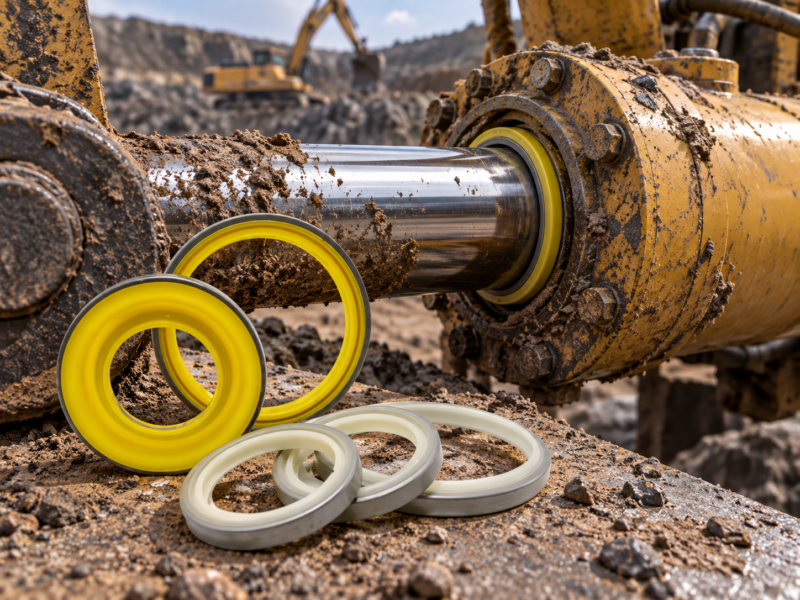
Wiper seals for construction and mining cylinders are the first barrier against external contamination carried toward the gland during rod retraction. Their practical job is to remove dust, mud, slurry and adhered debris from the exposed rod before those contaminants can move into the rod-seal area.
The selection challenge is that contamination does not behave the same way in every machine. Fine quarry dust may remain loose on the rod, wet clay can form a persistent film, slurry combines moisture with abrasive solids, and dried mud or ice can become a rigid obstruction. A useful wiper decision therefore starts with the actual contaminant, then checks scraper-lip contact, rod condition, housing retention and the relationship between the wiper and the primary rod seal.
Match the wiping system to what actually builds up on the rod.
Dry dust calls for consistent particle removal. Wet mud and slurry require effective scraping of an adhering layer. Packed or hardened debris adds a mechanical-clearance problem around the gland. At replacement time, inspect the rod surface and housing as carefully as the wiper itself; repeated contamination or leakage often points to a system condition rather than a single worn lip.
Start by identifying the contamination, not by choosing a seal profile
Construction and mining equipment can expose hydraulic rods to several types of external contamination during the same shift. Treating all of them simply as “dirt” makes it harder to understand why a wiper is leaving a film, wearing unevenly or allowing material to move toward the gland. The most useful first question is what the contaminant does when it reaches the rod.
Fine dry dust
Fine particles can coat a long section of exposed rod and return to the scraper lip on every retracting stroke. The important field observation is whether the wiping edge leaves a clean and consistent rod surface behind it.
Wet mud
Mud behaves differently because moisture and fine solids form a layer that can stick to the rod. The wiper has to separate that layer from the surface before retraction carries it toward the gland.
Slurry and sticky fines
Slurry can combine adhesion with abrasive particles. Once those solids reach the sealing area, contamination and surface damage may reinforce one another: particles abrade the lip while scratches make consistent wiping more difficult.
Ice, dried mud and packed debris
Hardened deposits create a mechanical obstruction rather than a loose coating. If material has dried, frozen or become tightly packed around the gland, forcing the rod through it can damage the scraper edge or prevent removed material from clearing away.
After defining the contamination environment, teams can compare wiper requirements with the wider hydraulic and pneumatic seal range without reducing the decision to dimensions alone.
Follow the contamination path during rod retraction
Understanding how wiper seals keep mud out of hydraulic cylinders is easier when the retraction stroke is treated as a sequence. External material first settles or adheres to the exposed rod. The moving rod then carries that material toward the scraper lip. The wiper must remove it at the boundary before the rod continues inward toward the primary rod seal.
Dust, mud, slurry, ice or packed solids settle on or adhere to the exposed rod surface.
During retraction, the wiping edge must separate material from the rod while maintaining stable contact.
Material left on the rod can move toward the rod seal and may contribute to wear, surface damage or repeat leakage symptoms.
A wiper should not be judged only by its appearance when the machine is parked. Before inspecting the rod or gland, secure the equipment and follow the manufacturer’s isolation and pressure-release procedures. Look for residue on accessible rod surfaces, buildup at the gland face and evidence of contamination past the wiper where the assembly can be inspected safely.
How to select wiper seals for construction and mining cylinders
Wiper seal selection for construction equipment should connect three physical interfaces: scraper-lip contact, the condition of the rod surface and the way the wiper is retained in the housing. A fourth check is then needed at system level: whether the wiping action works appropriately alongside the primary rod seal.
The wiping edge needs consistent contact so contamination is removed rather than pushed inward. Uneven or damaged contact can leave a film or line of material. The practical inspection is not simply whether the lip touches the rod, but whether it wipes consistently across the full circumference during movement.
The rod is the running surface for the wiper. Scratches, corrosion, dents and adhered deposits can damage the scraper lip or interrupt wiping contact. If replacement wipers repeatedly deteriorate on the same cylinder, the rod surface should move high on the diagnostic list.
The wiper must remain correctly seated while the cylinder cycles and while debris accumulates outside the gland. Corrosion, damage or retained contamination in the seating area can allow movement or distortion, so housing condition belongs in the replacement decision.
The wiper controls external contamination while the primary rod seal controls hydraulic fluid at the moving rod. Both rely on the same running surface. If the rod finish, housing condition or one of the sealing elements is compromised, replacing only the most visible component may leave the failure mechanism unchanged.
This distinction matters when evaluating heavy-duty wiper seals for dusty environments. “Heavy duty” is not a substitute for application information. Particle type, buildup behavior, rod condition, housing arrangement, duty cycle and realistic maintenance frequency still need to be confirmed before a specific profile or part can be selected.
For the wider relationship between cylinders, dynamic seals and other fluid-power interfaces, the CBD SEALS Fluid Power System page provides additional system context.
Five signs that the wiper or surrounding hardware needs inspection
The signs of a worn cylinder wiper seal are not limited to a visibly torn lip. In dusty or muddy service, the pattern left on the rod and the condition of the housing can be more useful than the outer appearance of the wiper.
A contamination track continues behind the lip
A line or film remains on the rod after it passes the wiping edge. Inspect lip contact, localized damage and the rod surface before assuming the environment alone is the cause.
The scraper edge is cut, rolled or uneven
Localized damage can point to hardened debris, rod defects or installation damage. Match the damaged area to the rod and housing before discarding the old part.
The wiper has moved in its housing
Lifting, loosening or partial displacement changes the lip-to-rod relationship. Clean and inspect the seating area before installing another component.
The rod shows scoring or corrosion
Repeated lines, pits or rough areas in the working zone can damage a new wiper quickly. Inspect the full section of rod that passes through the gland, not only the portion visible when parked.
Leakage returns after repeated seal replacement
Recurring leakage should widen the inspection to the rod, housing, primary rod seal, contamination path and mechanical condition. Another wiper change may only reset the symptom.
Use the operating environment to set the maintenance priority
A field inspection becomes more useful when the actual contamination determines what technicians check first. This matrix is a diagnostic aid rather than a product-specification chart.
The maintenance interval matters as much as the contaminant name. Equipment that can be cleaned frequently presents a different operating reality from cylinders expected to cycle for long periods with material accumulating around the gland. Selection should reflect the maintenance window that will actually exist in service.
Do not install a new wiper until the rod and housing have been checked
A replacement procedure should preserve enough evidence to explain why the old component deteriorated. Cleaning everything immediately and discarding the old wiper can erase useful clues such as one-sided wear, embedded particles, local cuts or signs of displacement.
Observe the contamination pattern before teardown
Record where material collects, whether the rod remains dirty after retraction and whether the wiper is still evenly seated. Photos taken before cleaning can help maintenance teams compare repeat failures.
Clean the exposed area without dragging debris inward
Remove external contamination sufficiently to inspect the gland and rod. The purpose is not cosmetic cleaning; it is to expose the surfaces that control seating, contact and contamination exclusion.
Inspect the complete working rod surface
Look for scoring, corrosion, dents, adhered particles and hardened deposits along the section that actually passes through the wiper. A defect outside the parked inspection zone can still cross the lip during the stroke.
Check housing seating and retention
Inspect the installation area for corrosion, retained dirt, damage or other conditions that could prevent a replacement from sitting correctly. A new part installed into a compromised housing starts service with the previous cause still present.
Widen the inspection when contamination or leakage repeats
External contamination and hydraulic leakage can appear together without having one single cause. If dirt has migrated inward or leakage returns, inspect the wiper, primary rod seal, running surface and associated hardware as one system.
Common maintenance error: replacing a visibly damaged wiper while ignoring the sharp rod defect, hardened deposit or damaged housing that caused the damage. The replacement can fail at the same location for the same reason.
What to record before requesting hydraulic cylinder wiper seal options
A useful supplier discussion starts with environmental and dimensional information rather than a generic request for a “construction wiper” or “mining dust seal.” Two cylinders on similar machines can face very different contamination, cleaning frequency and rod conditions.
Describe the real operating environment
- Machine and cylinder application.
- Fine dust, sand, wet mud, slurry, sticky clay, ice or mixed debris.
- Whether contamination stays loose, adheres to the rod or packs around the gland.
- How frequently the cylinder cycles.
- How often the rod and gland can realistically be cleaned or inspected.
- Whether deposits harden during storage, cooling or long idle periods.
Record the component condition
- Rod and available housing dimensions.
- Existing seal or wiper identification where available.
- Current housing configuration and seating condition.
- Rod scratches, corrosion, dents or adhered deposits.
- Visible lip damage, displacement or uneven wear.
- Contamination tracks and any recurring leakage symptoms.
- Clear photographs or drawings where useful for technical review.
Select according to the real contaminant and the maintenance conditions that exist in service. At the same time, inspect the rod surface, housing and primary sealing components. Dimensions tell the supplier what can physically fit; environmental and condition information explains what the wiper must actually deal with.
Material, profile and final dimensional decisions should be based on verified application requirements rather than assumed from words such as “construction,” “mining” or “heavy duty.” If a product page does not provide enough information to confirm the application, supplying contamination details, existing dimensions and failure evidence is a better next step than choosing by appearance.
Use specific wiper references only after the application has been identified
CBD SEALS lists Caterpillar-specific wiper references on its site, including products categorized as press-in wiper seals. These pages are useful when the existing assembly can be identified by part number; they should not be treated as universal replacements for construction or mining cylinders with unknown geometry.
 099-3929 0993929 Wiper Seals for Cat
Relevant when the existing cylinder or parts documentation identifies this exact reference. Before selecting it, confirm the installed part number, housing arrangement, rod condition and the contamination environment that caused the service issue.
3E-4162 3E4162 Wiper Seals for Cat
Relevant when the machine documentation or removed part matches this reference. Selection should still include a rod and housing inspection so the replacement is not installed into the same damaging condition.
If the part number is not known, use the CBD SEALS product shop or the hydraulic and pneumatic seal category as a product-discovery path, then confirm the application information before ordering.
Match the wiper to the real contamination path, not only the cylinder size
The most useful way to evaluate wiper seals for construction and mining cylinders is to start outside the cylinder and follow contamination inward. Identify what reaches the rod, determine whether it is loose or strongly adhered, observe how the wiping edge removes it, and then check whether the rod and housing allow that wiping action to remain consistent.
Dry dust, wet mud, slurry, packed soil and ice create different inspection priorities. A maintenance team that records those differences can make a better purchasing decision and can also recognize when the correct next action is not another wiper replacement but rod repair, housing correction or a broader cylinder inspection.
The same method improves communication between OEM, MRO and maintenance teams and the seal supplier. Instead of sending only a nominal size, provide the contamination environment, rod and housing information, maintenance interval and observed failure pattern. That turns a parts request into an application-based selection process.
Wiper seal questions for construction and mining cylinders
What is the role of a wiper seal in a hydraulic cylinder?
A wiper seal, often called a scraper seal, removes external contamination from the exposed piston rod as the rod retracts. It helps stop dust, mud, moisture and debris from being carried toward the primary rod-seal area.
How does mud damage cylinder seals?
Mud can adhere to the rod and move toward the gland during retraction. Fine solids may contaminate the sealing area and contribute to abrasive wear, while dried or packed mud can mechanically damage the wiping edge or interfere with its movement.
What are the signs of a worn wiper seal?
Look for contamination remaining on the rod after it passes the lip, cuts or deformation at the wiping edge, a wiper that has moved in its housing and dirt appearing behind the wiper. Rod scoring or recurring leakage should trigger a wider inspection rather than being blamed on the wiper automatically.
Should the rod surface be checked when replacing a wiper seal?
Yes. The scraper lip works directly against the rod. Scoring, corrosion, dents and hardened deposits can damage a replacement or prevent consistent wiping, so the working section of the rod should be inspected before another wiper is installed.
What application details are needed to select a wiper seal?
Useful information includes the cylinder application, contamination type, rod and housing dimensions, existing wiper identification, rod condition, maintenance frequency and observed symptoms such as contamination tracks, lip damage, displacement or recurring leakage.
Turn the field condition into a useful wiper seal request
Record what is collecting on the rod, how the material behaves during retraction, the available rod and housing information and any visible damage. That gives the next product or technical discussion a stronger starting point than machine type or dimensions alone.