
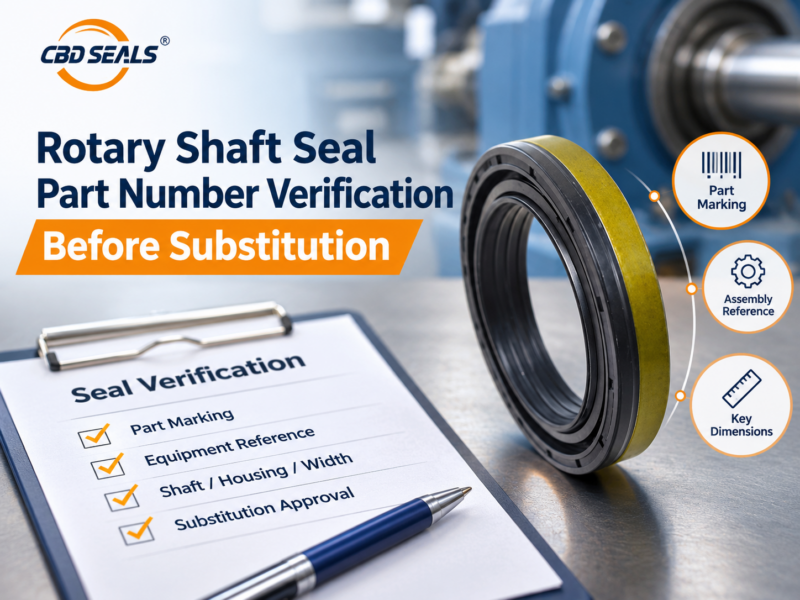
Rotary shaft seal part number verification must establish more than a resemblance between two product codes. Before accepting a substitute, identify the old seal, link it to the correct equipment or assembly, and confirm the documented shaft diameter, housing bore, width and configuration.
Matching numbers or dimensions can narrow the search, but neither automatically proves interchangeability. If the marking is incomplete or the records disagree, the replacement should remain a candidate until the discrepancy is resolved and the necessary approval is documented.
Is the Old Part Number Enough to Approve a Substitute?
The old number is the best place to begin when its origin can be established. A marking on the removed seal can be checked against a manufacturer designation, an equipment parts list or a drawing. It is an identification lead, however, rather than a complete approval for a different part.
Prefixes, suffixes and revision characters may distinguish variants within a numbering system. Two codes can look nearly identical and still refer to different configurations. Likewise, a supplier cross-reference may point to a candidate without confirming that the equipment manufacturer accepts it for the assembly in question.
A similar part number identifies something worth checking. An approved substitute needs a traceable connection to the original assembly and its requirements.
This distinction is easy to lose in a purchasing conversation. A replacement might have appeared on an earlier invoice, yet that invoice does not explain whether it was the original part, an authorized supersession or an alternative chosen for a previous repair. Preserve the reference, but verify what it actually represents.
Record Markings and Equipment or Assembly References
Start with the removed seal. Transcribe its marking exactly, including letters, numbers, spaces and suffixes, and photograph it before handling makes the remaining characters harder to read. Unknown characters should stay unknown. Completing a partly visible number from memory can make a weak identification look deceptively certain.
Then establish the assembly identity: equipment manufacturer and model, the component from which the seal was removed, and the relevant serial, drawing or parts-list reference where available. A seal marking, an equipment part number and a supplier replacement designation are not necessarily the same kind of reference, even when all three are related.
This is also the point at which the broader industrial oil and rotary shaft seal options become relevant. A supplier range can help locate a product family, but the equipment information is what makes the search specific enough to assess a proposed replacement.
Previous purchase records may help trace a change in designation, although they should not silently override the equipment documentation. Note whether each number came from a removed part, original drawing, service record or supplier catalog. That small distinction saves time when two records appear to conflict.
Cross-Check the Key Dimensions and Documented Configuration
Part-number research should be supported by the actual dimensional requirement. For many rotary shaft seals, three values provide the starting comparison: shaft diameter, housing bore and seal width. They establish whether the proposed part fits the intended dimensional envelope, not whether every aspect of the design is equivalent.
Shaft Diameter
Use the nominal shaft diameter specified at the sealing position. If a direct measurement is available, record it separately with the unit and measurement source. The apparent opening in a removed seal is not a reliable replacement for the nominal shaft requirement, and a difference between the drawing and measured shaft should be investigated rather than concealed.
Housing Bore
Check the housing opening intended to receive the seal. The outside diameter of a removed seal may have changed through distortion or damage, so the relevant housing drawing or independently verified bore measurement provides a stronger reference. Confirm that two compared figures describe the same feature and use the same units.
Seal Width
Compare the specified seal width with the documented axial space in the assembly. Available housing depth and seal width are related, but they are not interchangeable measurements. A candidate that appears to fit in the space should not be approved until any difference from the original requirement has been reviewed.
Even when shaft diameter, housing bore and width agree, the proposed seal may differ in lip arrangement, sealing direction, case construction, elastomer compound or spring design. Check these details against the original drawing or manufacturer’s technical data, then confirm that the candidate is suitable for the lubricant or process medium, operating temperature, shaft speed and any relevant pressure or contamination exposure. Matching dimensions make a candidate worth investigating; they do not establish interchangeability.
Resolve Missing or Conflicting References Before Substitution
When the marking is partly unreadable, the first task is to recover the original identity. Retain the visible characters and compare them with the correct assembly record, original packaging where available and manufacturer information. If several numbers remain plausible, keep them separate rather than selecting the closest-looking one.
A dimension mismatch needs a different investigation. Confirm units, drawing revisions and component identity, then review whether a measurement taken from the removed part could be distorted by its condition. The fact that the number appears correct is not sufficient reason to ignore a conflicting shaft, bore or width value.
For a suggested supplier equivalent, ask what the cross-reference actually proves. A documented manufacturer’s supersession is not the same as a supplier-proposed alternative, and neither should be presented as equipment-approved without the relevant basis. Any unresolved difference should stay visible in the replacement request.
The next step depends on where the uncertainty lies. An incomplete marking calls for better identification records, while a dimensional conflict may point to an outdated drawing, a measurement error or the wrong assembly reference. If the difference concerns seal construction or operating suitability, technical confirmation is needed before the proposed replacement can be approved.
Keep Approval Evidence Attached to the Replacement Request
The verification process is only useful if its reasoning travels with the order. A purchase request containing a new part number but no supporting record can obscure why that substitute was selected. It also makes a later change in supplier or equipment documentation unnecessarily difficult to evaluate.
A concise replacement file should carry the original marking and photographs, equipment or assembly identification, relevant drawing or parts-list reference, and the three key dimensions with their sources. Add the full candidate designation, the document supporting its proposed relationship to the original, and a note explaining any difference.
Most importantly, distinguish between a part that has been identified, one whose dimensions have been checked, and one approved for substitution. These are different conclusions. A request marked “same size” cannot replace a documented decision about configuration and assembly applicability.
Where approval is required, retain the responsible authority, decision and applicable documentation revision. Where it is still pending, say so. A readable evidence trail helps both maintenance and procurement review the replacement without treating assumptions as established facts.
Review the Industrial Rotary Sealing Options
After the original reference, equipment identity and key dimensions have been established, a relevant product listing can provide the next comparison. CBD SEALS publishes part-number-specific rotary sealing products alongside its wider industrial and automotive sealing range. A catalog listing is useful for locating a known designation, but it does not prove a substitute for an unidentified or different assembly.
The following CBD SEALS drive shaft seal is one example of why the complete number matters. It is shown as a reference for an identifiable product page—not as a universal replacement for other rotary shaft seals. It is worth reviewing only when the original reference and equipment requirements support that particular application.

1197045 / 119-7045 Drive Shaft Seal for Caterpillar
This part-number-specific listing illustrates how a confirmed designation leads to a particular catalog entry. Before considering it for a replacement, check the existing part number, equipment or assembly reference, required dimensions and supporting technical evidence. Visual similarity alone does not establish a match.
For other rotary sealing requirements, the Industry & Automotive sealing solutions range provides the relevant commercial overview. Where an original marking or an equivalence remains uncertain, include that uncertainty in the enquiry rather than presenting a candidate as already approved.
Frequently Asked Questions
What if the old marking is partly unreadable?
Record the visible characters exactly and mark the rest as unknown. Compare photographs with equipment or assembly documentation and original packaging where available. Do not complete a number by guesswork.
Do identical dimensions prove interchangeability?
No. Matching shaft diameter, housing bore and width supports dimensional identification, but the documented configuration and application-specific approval may still differ.
Can a supplier cross-reference replace equipment confirmation?
It can support a proposed match, but its source and scope must be checked. A supplier suggestion should not be treated as an equipment-approved substitution without appropriate evidence.
Which photos help verify the original reference?
Use a clear close-up of the full marking, photographs of both faces and an overall view of the removed seal. Original packaging and equipment identification photos can add useful context. Confirm dimensions by reliable records or measurements rather than images alone.
Review a Rotary Shaft Seal Replacement Reference
Prepare the old seal’s complete visible marking, equipment or assembly information, shaft and housing dimensions, seal width, and the documented basis for the proposed substitute. Include any unreadable characters or differences that remain unresolved.