
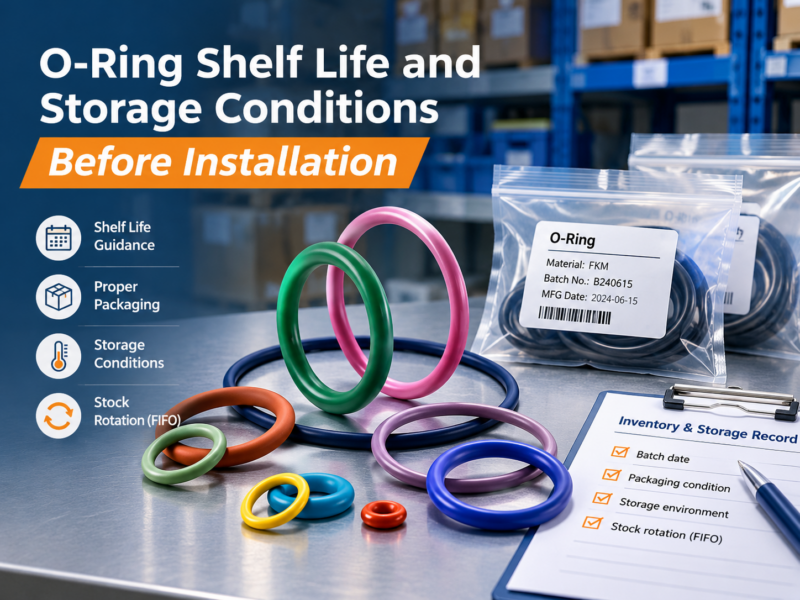
O-ring shelf life describes how long an unused seal may remain in controlled storage before installation or a required review. It is not a prediction of how long the seal will last in service. Whether a stored ring is suitable for use depends on the elastomer, the applicable supplier guidance and what happened to that particular lot while it was stored.
Two O-rings that look identical may have very different storage histories. One might have a clear lot record and controlled conditions; the other may have been moved between bins with its identity lost. Understanding O-ring storage conditions and shelf life means knowing which evidence still applies to the seal in hand—not simply trusting the date printed on a bag.
Why the Age of an O-Ring Is Only Part of the Answer
Age is a useful starting point, but it cannot account for a ring stored in sunlight, squeezed beneath heavy cartons or separated from its batch label. Those events matter in different ways: exposure may affect material condition, while a missing label may make the correct shelf-life rule impossible to establish.
A sealed bag with a readable lot number can be checked against the supplier’s date information and storage guidance. A loose group of similar-looking rings is different. Even if the rings are clean and flexible, their appearance cannot show whether they came from the same batch or were kept under the same conditions.
That distinction becomes important when stock is repacked or batches are mixed. One carton label cannot provide evidence for every ring once its original identity has been lost. The uncertain parts need review before they can be treated as available for assembly.
Why Shelf Life Differs Between Materials and Standards
There is no single storage period that applies to every elastomer. The compound, the relevant specification and sometimes the packaging or order requirements all affect the period used for review. A material name on its own is not enough to assign an expiry date to a shipment.
The date used to start that period matters just as much. A goods-receipt date tells the warehouse when a shipment arrived, not when the rubber was manufactured or cured. If the supplier’s rule uses the earlier date, counting from delivery can make older stock appear newer than it is.
The difference is clear in published policies. Parker’s O-Ring & Engineered Seals Division lists 15 years for NBR and an unlimited period for FKM under its stated conditions. Trelleborg’s ISO 2230-based guidance instead uses initial periods of seven years for NBR and ten years for FKM, with inspection and possible extension afterward. These are different published approaches, not interchangeable expiry dates or CBD SEALS product guarantees. The applicable rule still has to be established for the actual compound and lot.
An opened bag does not restart the shelf-life clock, and a review date is not something to replace with a new packing date. Where the specified period has passed, the outcome depends on the inspection or extension process allowed by the governing documentation.
If a lot cannot be released, replacement becomes a separate question. The O-rings for your application category is a place to explore alternatives, but choosing a new part does not establish that the old stock was acceptable.
How Storage Conditions Affect an O-Ring Before Installation
Original packaging helps protect rings from unnecessary exposure and keeps their identity with the batch. But an intact bag cannot offset years of poor storage. Heat, contamination and light can still matter even when the packaging looks undisturbed.
Ultraviolet light, ozone generated by certain electrical equipment, and contact with unsuitable chemicals can affect elastomers, depending on the formulation. Condensation and nearby heat sources add uncertainty. A seal need not show obvious cracks for its storage history to deserve closer attention.
Temperature and humidity are also part of that picture. Trelleborg’s ISO 2230-based guidance prefers storage at about 15°C, recommends not exceeding 25°C and calls for relative humidity below 70% (below 65% for polyurethane), without condensation. Those are reference conditions for that guidance, not universal acceptance limits for every O-ring. A warehouse thermostat reading also cannot tell you what an unmonitored shelf experienced during a heat or moisture excursion.
A torn bag does not automatically mean an expired O-ring. What matters is what the tear allowed to happen. Was the ring exposed to dirt or moisture? Is its lot label still traceable? If the exposure cannot be assessed against the relevant requirements, the stock needs review before use.
The same applies to a bag opened during normal picking. Remaining rings may still be suitable if they have been protected and identified as required. Resealing the bag should preserve the original lot information; it does not create a fresh shelf-life start date.
What Happens When Rings Are Compressed or Mixed in Storage
Clean packaging is not always enough to protect an O-ring’s shape. A bag buried under heavy cartons may leave its contents distorted. Large rings kept tightly stretched on hooks can be affected by the strain, while small rings crowded into a bin may be pinched or sharply bent. The way stock is arranged can matter as much as the bag around it.
Mixing batches creates a different problem. Two rings may share a nominal size but not the same compound, manufacturing date or release status. Topping up a partly used bin with a newer batch makes those differences hard to recover unless each lot remains separately identifiable.
That is why first in, first out (FIFO) is not always the right basis for issuing O-rings. If one lot has a pending review date or a quality hold, its condition and status matter more than which carton arrived first.
What to Do When a Stored Lot Is Uncertain
The difficulty often becomes visible only when a maintenance team needs a ring quickly. A package has been reboxed, a label no longer matches the contents, or nobody knows whether the storage area had a temperature excursion. In each case, the decision depends on how much of the original evidence can still be connected to the physical lot.
When the records support use
A lot with intact identification, a known date basis and evidence of acceptable storage can be assessed against the relevant release criteria. Its inspection findings still matter, but a clean surface alone is not the reason the lot can be used.
If the lot meets those requirements, its identity should remain linked to the assembly or maintenance record wherever traceability is required. That connection is what makes the decision defensible later.
When the history is incomplete
A missing cure date or an unidentified repacked bag does not prove that the rubber is damaged. It does mean that the usual basis for release is incomplete. Supplier records or receiving documents may recover the missing history; until then, the affected stock should remain on hold.
The delivery date cannot simply stand in for the manufacturing date. If the original history cannot be reconstructed, any alternative acceptance would need to follow the applicable quality procedure rather than an informal assumption.
When the material shows deterioration
Cracking, cuts, unusual stickiness, contamination or lasting deformation point to a different kind of concern. The affected rings should be kept out of accepted inventory while the condition and any shared storage incident are examined.
Visible damage warrants attention, but absence of visible damage is not proof of unchanged properties. The applicable rejection or review criteria—not the ring’s appearance alone—determine the outcome.
If a Stored O-Ring Needs Replacing
Once a batch is rejected or cannot be cleared for use, the replacement should be specified from the controlled drawing or part record—not by measuring an old ring that may have changed shape in storage. The original compound, part number, nominal dimensions and drawing revision are more reliable starting points.
Where the original specification uses an AS568 designation, the AS568 O-ring size chart can help confirm the dimensional reference. It cannot establish material identity or tell you whether the stored lot is fit for installation.
For a replacement enquiry, the most useful information is the known specification together with any uncertainty about the old batch. That lets the next order be checked without treating an untraceable O-ring as a reliable sample.
Frequently Asked Questions
Does opening a bag automatically end shelf life?
No universal rule makes the opening date an automatic expiry date. Check the applicable packaging and storage instructions, document the opening, and determine whether the remaining stock still meets the release requirements.
Can appearance prove a stored O-ring is usable?
No. Inspection can reveal damage, contamination or deformation, but it cannot establish the full storage history, material identity or absence of less visible changes. The required records and acceptance criteria must also be satisfied.
What if the manufacture date is missing?
Hold the lot while checking supplier and batch records. Do not substitute the delivery date for the manufacture or cure date without evidence. An authorized review must determine whether any alternative release basis is acceptable.
Should different compounds share a storage label?
A shared warehouse-location label does not replace individual material and lot identification. Each controlled stock unit should remain traceable to its compound, batch and applicable shelf-life or review status.
If an existing lot cannot be used, share the known compound, part number or dimensions and any available details from the original batch. Missing information can be flagged when discussing replacement options.