
Choosing an oil seal for grease-lubricated bearings starts with understanding what the seal is expected to do. It may need to retain grease, keep dust and moisture away from the bearing, or perform both jobs. The right design depends on the lubrication arrangement, shaft conditions, available installation space, and the environment in which the machine operates.
Grease generally stays in place more readily than free-flowing oil, but that does not make every seal interchangeable. A bearing that runs in a clean enclosure has different requirements from one exposed to abrasive dust or frequent washdown. The way fresh grease enters the housing and excess grease leaves it also affects the choice.
The starting point: establish whether grease retention, contamination exclusion, or both are the main priorities. Physical fit comes next, followed by the operating conditions that determine whether the seal can perform reliably.
In this article
What must an oil seal do in this grease-lubricated bearing arrangement?
In a relatively clean enclosure, the main job may simply be to limit grease escaping from the bearing area. A bearing exposed to dust, moisture, or process debris faces another problem: keeping those contaminants away from the rolling elements and lubricant. Some machines need both forms of protection.
It helps to look at the bearing arrangement before choosing an additional seal. Is the bearing open, shielded, or already supplied with integral seals? Is the external oil seal the primary barrier, or is it being added to protect an existing bearing from the surrounding environment? This distinction matters because an extra sealing element should solve a specific problem rather than duplicate protection already provided by the assembly.
The intended function also influences lip orientation. A conventional radial shaft seal used mainly to retain grease often has its primary lip facing the lubricant. Where contamination exclusion is the main concern, the arrangement may differ. Multi-lip assemblies require closer attention to their cross-section and lubrication path, particularly when excess grease needs somewhere to escape during relubrication.
The surroundings are relatively clean, and the main concern is keeping grease within its intended region without unnecessary friction at the shaft.
Dust, dirt, moisture, or process debris can reach the shaft opening, so the sealing arrangement needs to protect the bearing from outside contamination.
Once the main function is clear, comparing seal profiles becomes much more useful. It gives the selection process a practical direction instead of starting with a part number and trying to make it fit the application.
Describe the grease and the operating cycle
The grease itself is an important part of the selection. Its specification, supply method, and contact with the seal material all influence performance. Temperature matters too: a seal that works under normal conditions may behave differently when the equipment experiences repeated heat peaks. Record the grease specification and actual operating temperature range, and consider whether the lubricant or other process media are compatible with the proposed seal material. CBD SEALS’ guide to oil seal temperature limits provides further context for this part of the decision.
How the bearing receives grease can be just as important as which grease it uses. A bearing packed during assembly and left undisturbed has different requirements from one that is replenished regularly. During relubrication, fresh grease displaces some of the existing lubricant. If the housing has no suitable escape route, pressure and accumulated grease can affect the sealing arrangement.
This is why the lubrication path should be considered alongside the seal itself. SKF’s CR Seals Handbook discusses sealing arrangements for grease retention and frequent relubrication. The distinction is useful when deciding whether the housing needs a controlled route for excess grease rather than a more restrictive sealing arrangement.
With these conditions understood, the industrial oil and rotary shaft seal options from CBD SEALS provide a relevant product range to review. The appropriate profile depends on the actual lubrication arrangement, not simply on the fact that the bearing uses grease.
Grease loss and intentional purging are not the same thing. Grease appearing outside a housing after maintenance is not necessarily evidence of seal failure. The equipment’s intended lubrication and purge route helps explain whether the grease is escaping unintentionally or leaving through a designed path.
The shaft’s operating pattern completes the picture. Continuous rotation, repeated starts and stops, intermittent operation, and long idle periods create different conditions at the sealing lip. If grease does not reliably reach a contacting lip, the fact that the bearing itself is lubricated does not automatically mean the seal interface has adequate lubrication.
Confirm shaft speed and the shaft or housing dimensions
Shaft RPM is a useful starting point, but it does not tell the whole story. The lip runs against the shaft at a particular contact diameter, so its surface speed depends on both rotational speed and shaft diameter. At the same RPM, a larger contact diameter produces a higher sliding speed at the lip.
For that reason, provide the normal operating speed as well as any higher-speed periods. Reversing direction, frequent starts, and intermittent running are also worth mentioning. These details help distinguish a machine that runs steadily from one that repeatedly changes operating conditions.
Dimensions need the same attention. The shaft diameter at the actual seal running position, housing bore, and available axial width are more useful than the bearing designation alone. The bearing journal and nearby seal track may have different diameters, while the housing can have a separate recess for the seal.
The condition of the running surface matters once those dimensions are known. Include the shaft surface finish, any visible wear or grooves, and known runout or misalignment. The lip depends on a suitable contact track to maintain sealing without excessive wear. Where the shaft condition is uncertain, the factors discussed in shaft runout and surface finish are useful points of reference during inspection.

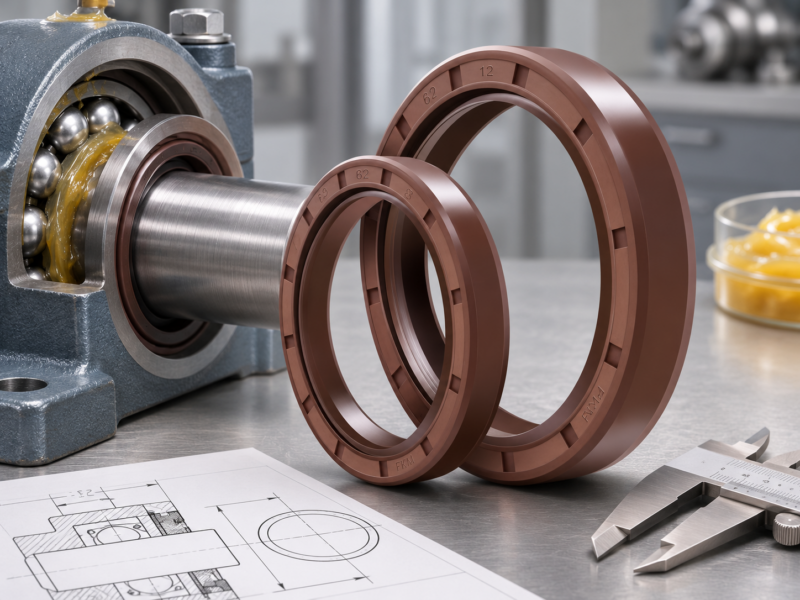
CBD SEALS rotary shaft oil seals. The product photo illustrates the seal family and its general construction.
Rotary Shaft Oil Seals
CBD SEALS lists TC/SC-type rotary shaft oil seals in its industrial and automotive offering. These are relevant designs to examine when a sealing lip runs directly against the shaft. The final choice depends on the shaft and housing dimensions, lubrication conditions, running speed, and the protection required by the application.
Compare clean and contaminated operating environments
Two bearings with identical shaft and housing dimensions can still require different sealing arrangements. The difference often comes down to what surrounds the machine and how easily outside material can reach the shaft opening.
When grease retention is the priority
Inside a protected enclosure, with little exposure to dirt or moisture, the main requirement may be to keep grease in its intended region without adding unnecessary rubbing contact. A relatively straightforward sealing arrangement may be sufficient when the bearing’s lubrication and operating conditions support it.
Adding more lips does not automatically improve the result. Each contacting lip introduces another friction point and may need suitable lubrication of its own. If there is no significant contamination problem for an additional lip to address, the extra contact may bring more friction without providing a meaningful benefit.
When contamination exclusion is the priority
A shaft opening exposed to abrasive dust faces a different challenge from one exposed to occasional moisture or repeated contact with wet dirt. The type of contaminant matters, as does how it reaches the sealing area. Describing the actual environment gives a clearer basis for selecting a suitable barrier than simply requesting a dustproof seal.
An auxiliary exclusion lip can provide another barrier before outside material reaches the primary sealing line. The differences between single-lip, double-lip, and dust-lip designs are relevant here, although the choice still depends on available space, shaft speed, lip lubrication, and the required level of protection.
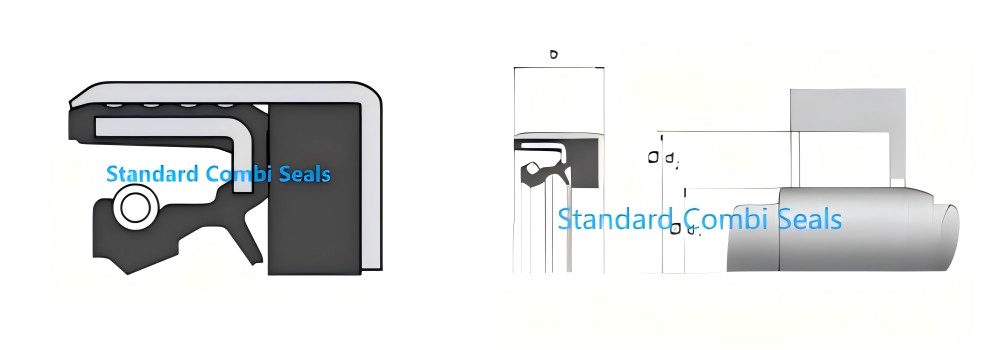
Combi Seal family illustration from CBD SEALS, showing a sealing arrangement designed to provide an additional contamination barrier.
Where a Combi Seal enters the discussion
The 12001881 CORTECO Combi Seal 35×50×10 NBR is a relevant example when an application calls for additional protection against external contamination. Its product listing specifies a maximum operating temperature of +80°C, a maximum speed of 5 m/s, and a pressure limit of 0.05 MPa. The product title identifies the seal as NBR, while the technical data lists NBR/FKM. Confirm the exact supplied lip compound and construction when reviewing this particular part.
Some installations need both reliable grease retention and substantial contamination exclusion. In these cases, the seal works as part of a wider arrangement involving the shaft, nearby barriers, bearing enclosure, and grease escape path. Looking at these elements together gives a more realistic basis for choosing the sealing design.
Turn the duty information into a selection inquiry
Once the sealing function is understood, the purchasing inquiry can focus on the conditions the seal will actually encounter. This is more useful than choosing a profile first and asking a supplier to confirm whether it fits afterward.
An inquiry containing only a shaft diameter and housing bore may still leave important questions unanswered. A continuously rotating machine in a clean enclosure has a different duty from an intermittently operated machine near dusty process equipment. Even when their installation dimensions match, their lubrication, contamination, and operating requirements may point toward different sealing arrangements.
A practical engineering record can bring the relevant information together without becoming a lengthy specification:
- Lubrication: grease product or specification, initial fill method, replenishment frequency, and the intended purge route.
- Material and temperature: relevant grease additives, process media or cleaning agents, and normal and peak operating temperatures.
- Installation: shaft diameter at the lip contact position, housing bore, available width, shaft surface finish, visible wear, and known runout or misalignment.
- Operating conditions: normal and maximum RPM, direction changes, starts and stops, operating cycle, and any pressure differential across the seal.
- Environment and sealing purpose: the type and frequency of contamination, existing protective barriers, and whether the main objective is grease retention, contamination exclusion, or both.
It is also helpful to separate measured values from estimates. A housing drawing may confirm the bore but say little about the condition of the shaft track. A few photographs, maintenance records, or a section drawing can clarify these details and give the technical reviewer a better understanding of the existing arrangement.
Keeping this information with the purchasing record also makes future replacements easier to assess. Instead of relying only on the dimensions of the previous seal, the next selection can be based on the operating conditions it was originally intended to handle.
Review the relevant industrial oil-seal options
With the application details in hand, comparing designs becomes more straightforward. A conventional radial shaft oil seal may be a suitable starting point when the main task is retaining grease around a rotating shaft. Where abrasive contamination is a greater concern, an auxiliary exclusion element or a more involved sealing arrangement may be worth considering.
The important distinction is whether the additional sealing feature addresses a real operating problem. A more complex design is not necessarily a better choice for a protected bearing, just as a basic retention seal may offer insufficient protection in a heavily contaminated environment.
CBD SEALS’ Industry & Automotive sealing solutions provide a starting point for reviewing the relevant product range. Where the application involves unusual operating conditions or incomplete measurements, a drawing and description of the existing arrangement can help narrow the options.
Frequently asked questions
Does grease lubrication remove the need for a seal?
No. Grease is generally easier to retain than oil, but a bearing may still need protection against lubricant loss or external contamination. Existing bearing shields and integral seals should be considered as part of the complete arrangement.
Can the same seal suit different shaft speeds?
Not automatically. The contact diameter, surface speed, lubrication at the lip, and specific seal construction all influence suitability. The actual operating conditions should be compared with the selected product’s published limits.
Should contamination conditions be included in the inquiry?
Yes. Describing whether the shaft opening encounters abrasive dust, moisture, or wet dirt helps establish how much external protection the bearing arrangement needs.
Is the bearing size alone enough to specify the seal?
No. The seal may use a different shaft diameter and housing recess from the bearing seat. The actual sealing dimensions and running conditions provide a more reliable basis for selection.
A good selection starts with the actual bearing arrangement. The grease, shaft conditions, operating cycle, and surrounding environment together provide a much clearer basis for comparing oil seal designs than the bearing size alone.
Discuss a grease-lubricated bearing seal requirement
Share the grease specification, shaft speed, sealing dimensions, and operating environment. A drawing or photograph of the existing arrangement can also help clarify the application before a suitable seal is selected.