
O-ring installation lubricant compatibility must be confirmed against the specific elastomer compound, not just the material family printed on a bag. The lubricant’s base fluid and additives must be suitable for the seal, while any residue must also be acceptable to the process medium, mating surfaces and assembly requirements. A product labeled “rubber-safe” is not automatically suitable for every O-ring.
Before assembly, identify the seal compound and lubricant formulation, establish where the lubricant will go and how long it may remain, then review supplier evidence for those conditions. If a critical part of that evidence is missing, leave the compatibility decision open rather than treating an unverified substitute as approved.
In this article
What Makes an Installation Lubricant Acceptable?
Installation lubrication can make a seal easier to seat and help reduce the risk of dragging, pinching or twisting as parts come together. Those benefits matter only if the lubricant does not introduce a different problem: swelling or shrinkage of the elastomer, unwanted residue, interference with the working fluid, or contamination of a sensitive assembly.
Acceptance therefore has two parts. Material compatibility asks whether the complete lubricant formulation is suitable for the actual rubber compound under the expected exposure. Application compatibility asks whether that lubricant is permitted at the specified location, temperature and process conditions. Passing one check does not establish the other.
A compatibility record should show how much of the decision is actually supported. For a practical pre-assembly review, use three decision states; they are not a universal industry rating.
Compatibility is supported when the evidence covers the identified lubricant, exact seal compound and intended conditions. It remains conditional when part of the pairing is documented but an important factor, such as retained contact, operating temperature or process cleanliness, is unresolved. It is not established when the compound, finished lubricant formulation or relevant exposure cannot be verified. These labels help prevent partial supplier information from being treated as full approval.
Check the Lubricant Formulation Against the Exact Compound
Lubricant labels typically describe a broad product type, not every component in the mixture. Two greases with the same advertised base type may use different thickeners and additive packages. Equally, two O-rings identified as FKM may be different compounds. A family-level compatibility chart is useful for screening, but it does not automatically approve a named lubricant against a named seal.
When the O-ring specification itself needs confirmation, review O-rings for your application and obtain the exact compound reference before approving an assembly lubricant.
The base fluid is where the check begins
Start with the lubricant’s documented base fluid, such as mineral oil, silicone oil or another specified formulation. Establish the precise product and grade rather than recording only “oil” or “grease.” The base fluid may influence elastomer swelling, changes in hardness or other properties, especially when residue remains in contact after assembly.
If an O-ring is intended to work with a particular system fluid, an unrelated assembly grease still requires its own review. Conversely, using the system fluid during installation should follow the equipment’s instructions and the confirmed seal-fluid compatibility; it is not an automatic permission.
Why additives and thickeners matter
Anti-wear agents, corrosion inhibitors, solvents, carriers and grease thickeners may change how a formulated lubricant behaves. Compatibility inferred from a base oil alone can miss these ingredients or changes introduced by a revised formulation. Ask whether the supplier’s approval refers to the finished lubricant rather than an isolated base-fluid component.
Also identify temporary assembly sprays or cleaners that may leave residues. A rapidly evaporating carrier can still contact the elastomer during fitting, and nonvolatile constituents may remain. Review these exposures rather than assuming that a product disappears completely once the joint is closed.
What supplier evidence actually proves
The most useful document names the lubricant product, the relevant elastomer compound or a defensible material range, the exposure conditions and any limitations. A technical data sheet may describe formulation and intended use; a safety data sheet is important for handling information but is not, by itself, proof of O-ring compatibility. Broad compatibility charts should be treated as screening references where they do not identify the actual compound or conditions.
For FKM, request confirmation that the particular lubricant formulation has been evaluated for the specified FKM grade and anticipated exposure. Do not turn a general statement about fluorocarbon rubber into approval for every Viton/FKM O-ring or every grease sold for seal assembly.
Review Contact with the Process Medium and Assembly Surfaces
Exposure after installation can change the decision. A lubricant applied to help a ring pass over a lead-in may be displaced almost immediately. Another application may trap residue inside a groove, leave it exposed to the process medium or carry it into a fluid circuit. Record the likely contact path, not just the moment of application.
Contact duration matters because a brief fitting operation is not equivalent to continuous immersion. But “assembly only” is not a complete exposure description if the lubricant stays behind the seal. Temperature during installation, startup and normal operation also belongs in the review, as does any cleaning or flushing step that might introduce a second chemical contact.
Consider the interaction with the working medium. Lubricant residue may mix with the fluid, separate from it, form deposits or create an unacceptable contamination risk. Check whether the equipment has filtration, cleanliness or process-purity requirements before introducing a substance that is not already approved for the system.
For FKM seals, assess the process medium separately from the installation lubricant. Our guide to Viton O-ring chemical compatibility explains how media composition, concentration, temperature and exposure pattern affect material selection.
The hardware needs attention too. A lubricant appropriate for the rubber may still be unsuitable for a mating surface treatment, coating, adhesive, plastic component or downstream process. For example, an assembly followed by coating or bonding may require stricter residue control than a conventional mechanical joint.
A useful record links the seal compound, lubricant identity, contact surfaces, process medium, temperature and expected contact duration. If any of these change, review whether the original acceptance still applies.
Decide Where and How Much to Apply Using Assembly Guidance
Compatibility approval does not decide the application method. Once a lubricant is accepted, the equipment or assembly instruction must establish whether lubrication is needed, where it may be applied and how excess material is handled. There is no universal quantity that suits every O-ring size, groove geometry, surface finish or process cleanliness requirement.
In many conventional assemblies, an approved light film can help the ring move over the installation surface and settle without twisting. That principle should not be converted into an instruction to coat every adjacent cavity. The instructions may permit lubrication of the seal, a lead-in surface, both or neither.
Check the actual installation path for sharp edges, threads, burrs and debris before relying on lubrication to reduce fitting force. Grease cannot make a damaged lead-in acceptable, and excessive application should not be used to conceal poor fit or incorrect groove geometry.
For repeatable production or MRO work, document the application tool, approved lubricant identifier, contact points and any instruction for removing visible excess. Avoid uncontrolled transfer from dirty gloves, shared brushes or open containers, particularly when the assembly has cleanliness requirements. After fitting, inspect for a seated, untwisted seal and for residue where it is not permitted.
If the procedure prohibits added lubricant, do not introduce one solely because lubrication is common elsewhere. Resolve difficult installation through the approved engineering route rather than improvising with an unverified fluid.
What to Do When Compatibility Evidence Is Missing
A missing compatibility statement is not evidence of incompatibility, but neither is it permission to proceed. Put the proposed combination on hold for technical review, especially when the lubricant can remain in service or enter a controlled process. The aim is to identify the exact gap so the supplier or responsible engineer can answer a focused question.
When asking for a technical review, provide enough context to make the answer specific.
Start with traceable identities: the O-ring part number and elastomer compound, alongside the lubricant manufacturer, full product name, grade and current technical documents. A safety data sheet can clarify handling hazards and any ingredients disclosed under applicable requirements, but it does not establish elastomer compatibility by itself.
Describe what the two materials will experience together. Include possible retained residue, installation and operating temperatures, process fluid, cleaners, adjacent materials and any cleanliness restrictions. The assembly procedure should identify the proposed lubrication points and method.
Finally, state exactly what existing evidence does not answer. A supplier can assess a named material-lubricant pairing far more meaningfully than a request asking whether a grease is suitable for “rubber” in general.
Where documentation remains inconclusive, the responsible engineering team may require a compound-specific assessment or controlled liquid-exposure test with agreed acceptance criteria. ISO 1817:2026 and ASTM D471-16a(2021) describe methods for evaluating changes in rubber properties after exposure to liquids. Define the test liquid, temperature, exposure duration, specimen or compound, and acceptance criteria before testing. These methods provide material-response data; they do not, on their own, qualify the complete seal design or assembled joint. Do not invent pass/fail limits or use an informal visual check as a substitute for an engineering decision. Record who approved the combination, which documents and revisions were reviewed, and what conditions the approval covers.
One lubricant need not be accepted across an entire O-ring inventory. Material or process changes can reopen the decision.
Confirm the O-Ring Product Before Assembly
Lubricant approval depends on knowing what is actually being installed. Before releasing the job, reconcile the O-ring part number, compound designation and relevant assembly requirement with the purchasing and maintenance records. A generic material name, matching dimensions or similar appearance cannot establish that two seals will respond identically to the same lubricant.
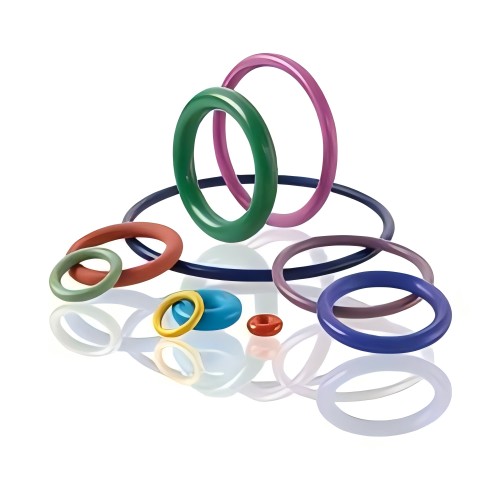
The O-rings category provides a starting point for identifying the seal family. When fluorocarbon rubber has been specified, the product reference below identifies the FKM product family only; it is not approval for any particular lubricant or process chemical. FKM chemical resistance varies by compound. Certain ketones, strong bases and amines can be unsuitable for many FKM formulations, while compatibility with esters also requires compound-specific confirmation. Check the actual medium and exposure conditions against relevant supplier data.
Viton/FKM O-rings
The pictured Viton/FKM O-rings are relevant when an assembly specifies fluorocarbon rubber. The image helps identify the product family, but cannot confirm compatibility with a particular grease or oil.
Release assembly only when the identified seal, named lubricant, contact conditions and application instructions are supported together. If a document covers only a broader elastomer family, keep that limitation visible in the record rather than reporting compound-specific compatibility as confirmed.
Frequently Asked Questions
Does a lubricant labeled rubber-safe cover every compound?
No. “Rubber-safe” is a broad product description, not proof of compatibility with every elastomer formulation. Check the finished lubricant against the specified compound and actual contact conditions.
Is a short assembly contact the same as continuous exposure?
No. Duration and temperature can change the relevance of compatibility evidence. A lubricant used during fitting may also remain trapped in a groove, so verify whether contact truly ends after assembly.
Should excess lubricant be removed?
Follow the equipment’s assembly and cleanliness instructions. Remove material from prohibited areas as specified; do not assume that leaving extra grease improves sealing or that all residue must be removed.
Can a color match confirm lubricant compatibility?
No. O-ring color does not reliably identify the exact elastomer compound, and matching the appearance of an existing seal says nothing about the proposed lubricant formulation. Use traceable part and material records.
Share the O-ring part number or drawing, specified elastomer if known, operating medium, temperature range and any cleanliness requirements. CBD SEALS can use these details to discuss relevant O-ring options and product information. Confirm the finished lubricant formulation against the exact compound and service conditions with the lubricant supplier and responsible engineering team.