
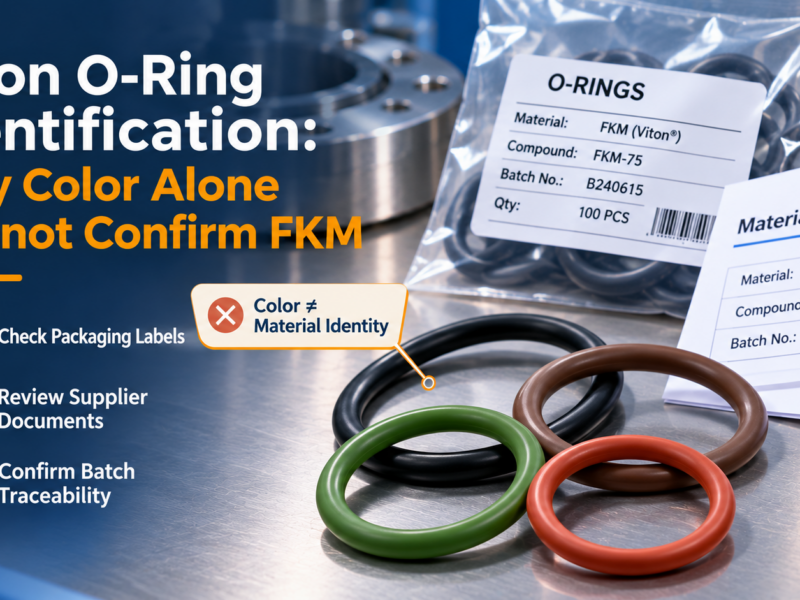
No. An O-ring’s color cannot prove that it is FKM, and it cannot establish that the material is genuine Viton-branded fluoroelastomer. Black, brown, green and other colors are used across different elastomer compounds. Two rings may look identical while their documented materials are different.
To identify FKM or Viton O-ring material, start with the supplier’s declaration, the specified compound or grade, and records linking that information to the actual package or batch. If the link is missing, material identity remains unverified—even if the ring resembles a previously approved part.
Appearance is a clue. Traceable documentation is the evidence.
If an O-ring has lost its original label, look for its purchase record or packaging reference first. Then compare that information with the supplier’s compound and batch documentation before deciding whether the part can be identified.
Can Color Prove That an O-Ring Is FKM or Viton?
Color may help distinguish parts within a supplier’s or maintenance team’s labeling system. It is not a universal code for polymer chemistry. Black O-rings can be made from FKM, NBR, EPDM and other elastomers; a brown or green ring is not automatically Viton.
Colorants, fillers, formulation choices and identification practices all affect appearance. Even within one material family, compounds may be produced in different colors. Conversely, visually similar rings may have different polymer families, hardness specifications or compound references.
A familiar failure point is an unmarked replacement taken from a maintenance drawer. It has the right dimensions and resembles the last seal removed from the machine, so the material is assumed to match. Neither similarity proves the elastomer family, nor does it establish the compound used.
A color code has value only when a documented specification assigns it to a particular material—and the code can be traced to the parts being inspected.
Record color as an observation if it helps distinguish stock. Do not treat it as an acceptance criterion unless the relevant identification procedure explicitly supports that use.
Separate the Material Family, Compound and Brand Claim
Purchasing descriptions often place “FKM” and “Viton” together, but they do not mean exactly the same thing. A broad material designation, an individual compound and a brand-origin claim answer different questions.
FKM names a family of fluoroelastomers, not one universal formulation. A compound or grade is more specific: it identifies a particular material formulation under a supplier’s or manufacturer’s designation. Viton is a brand name, so the generic term FKM does not establish a Viton brand claim.
Two seals labeled FKM may satisfy the same broad family description while having different compound specifications. If a drawing calls for a named grade, confirming the family alone leaves an important part of the requirement unanswered. A brand-specific requirement adds the need for evidence supporting that branded material claim.
CBD SEALS lists Viton/FKM O-rings for your application on a dedicated product page. That page is a useful starting point for discussing the product family, but a product listing is not a substitute for verifying an unidentified ring already in stock.
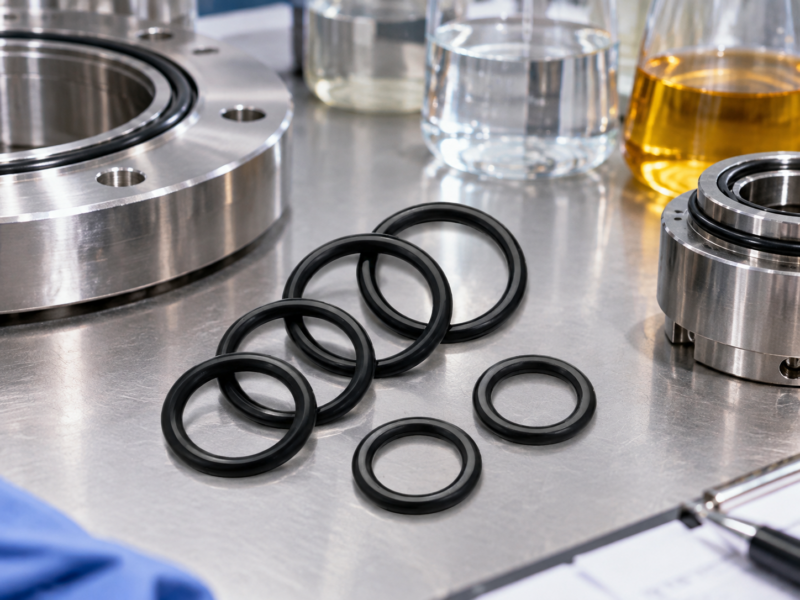
For a repeat order, use the documented material grade, O-ring dimensions and any available batch records to review suitable product options. These details give the supplier a clearer basis for confirming the replacement specification.
Match Packaging and Supplier Documents to the Actual Batch
Finding a document that says “FKM” is not the same as verifying the delivered O-rings. The central question is whether that record belongs to the particular package, item reference and batch under inspection.
Read the Label Before the Package Is Discarded
Retain the original label, including any supplier part number, material name, compound designation, lot number or shipment reference it contains. Not every supplier uses the same fields; record what is actually present rather than assuming a label includes full traceability.
A photograph of the package and its label can be valuable when several similar rings are held in stores. It preserves the original identifiers even if the parts are later transferred to smaller containers.
Compare the Grade With the Supplier Declaration
The next comparison is between the packaging and the material paperwork. Relevant evidence may include a supplier material declaration, compound specification, certificate of conformity or a test report appropriate to the purchasing requirement. These records serve different purposes and should not be treated as interchangeable.
For example, a general technical data sheet may describe an FKM grade without showing that the delivered O-rings were manufactured from it. A document linked to the supplied part and lot provides a more direct traceability trail. If Viton is specified by brand, ask how the paperwork supports that particular claim.
Check the Batch Reference, Not Just the Material Name
Compare the lot or batch reference on the packaging with the reference used in the supplier’s supporting records. Production, inspection and shipment numbers may differ, so the supplier may need to explain how they correspond.
Suppose a package identifies one batch while the material declaration names another. The matching compound name is useful, but it does not close the traceability gap. That discrepancy needs a documented explanation before the record is accepted as evidence for the received parts.
The decisive question: Can the supplier’s material declaration be linked to these O-rings, their packaging and the relevant batch?
Handle Missing or Conflicting Identity Evidence
An unmarked O-ring is not necessarily made from the wrong material. It is simply not identified to the level that a traceable purchasing decision may require. The sensible response depends on which parts of its history can still be recovered.
Look first for a link to the original supply: purchase-order references, goods-receipt records, retained packaging photographs, stockroom entries or supplier correspondence. A record describing what was ordered previously is not enough unless it can be connected to the specific rings now being assessed.
When the label, grade and batch references agree, the receiving team can assess the record against the purchasing requirement. Incomplete records call for the missing supplier declaration or a clearer batch link. A direct conflict between the label and paperwork should put the affected material on hold until the supplier can explain the discrepancy.
Where no reliable traceability survives, the ring remains unidentified. Depending on the consequences of using an unknown material, a controlled laboratory assessment or a replacement with acceptable documentation may be more appropriate than trying to infer the compound from appearance.
Hardness, weight, flexibility and appearance can provide observations, but none independently proves the complete compound identity. Improvised burning or chemical exposure tests are unsafe and do not provide a sound substitute for controlled verification.
Laboratory methods may help establish whether a sample is consistent with a claimed polymer family. Their limits still matter: evidence consistent with FKM does not automatically identify the exact recipe, the Viton brand origin or the production lot. Report only the level of identity the available evidence actually supports.
Confirm Identity Before Discussing Suitability
Establishing that a ring is FKM does not automatically make it suitable for a particular installation. Material identity asks what the part is; engineering approval asks whether that identified material meets the specified duty. Mixing these decisions can make a replacement look better supported than it really is.
Before moving to suitability, the record should be clear about the declared polymer family, the specified compound or grade, the identity of the delivered parts and the relevant batch link. A Viton brand requirement must be supported separately rather than assumed from an FKM label.
Only then can the engineering or quality team compare the identified material against the approved drawing, material specification and operating requirements. Once the material is identified, compatibility becomes the next decision. The CBD SEALS Viton O-ring chemical compatibility guide explains how to assess the fluid and operating conditions before approving a replacement.
Same dimensions do not mean same material. A replacement can match the original O-ring’s nominal size yet still lack the compound documentation required for approval.
Review the Identified FKM Product for a Repeat Order
Once the material identity is established, the next order should refer to the documented requirement rather than the old ring’s color. Preserve the approved part reference, compound designation, material or brand requirement and the records used to connect the original supply to its batch.
The next delivery needs its own receiving check. An earlier approval establishes what was ordered and why; it does not automatically establish that every subsequent package is the same compound or originates from an accepted batch.
Where an old seal has no surviving identification, the first procurement task is to reconstruct or establish a defensible material requirement. Use that requirement when reviewing product options rather than selecting an O-ring because its shade and dimensions seem familiar.
When contacting CBD SEALS, provide any available packaging label, supplier declaration, compound or grade reference, and details explaining which batch belongs to which document. Mark unknown or conflicting information clearly rather than filling gaps with assumptions.
Frequently Asked Questions
Are all black O-rings FKM?
No. Black O-rings can be made from FKM, NBR, EPDM and other elastomers. Color does not identify the polymer family without an applicable, traceable identification record.
Does an FKM label establish a Viton brand claim?
No. FKM is a material-family designation; Viton is a brand. A generic FKM label does not prove the source of a branded polymer.
Can hardness alone confirm material identity?
No. Different compounds and material families can have overlapping hardness values. Hardness can support a defined inspection requirement but cannot authenticate a grade, brand or batch on its own.
What if packaging and paperwork disagree?
Hold the affected parts under the relevant inspection procedure and ask the supplier to reconcile the part, compound and batch references. Do not approve material identity by choosing whichever record seems more plausible.
Check the Evidence Before Confirming the Replacement
Share the packaging label, supplier documents, grade or compound designation, and the relationship between the batch references. If any record is missing or inconsistent, identify the gap so the material discussion starts with what is actually known.