
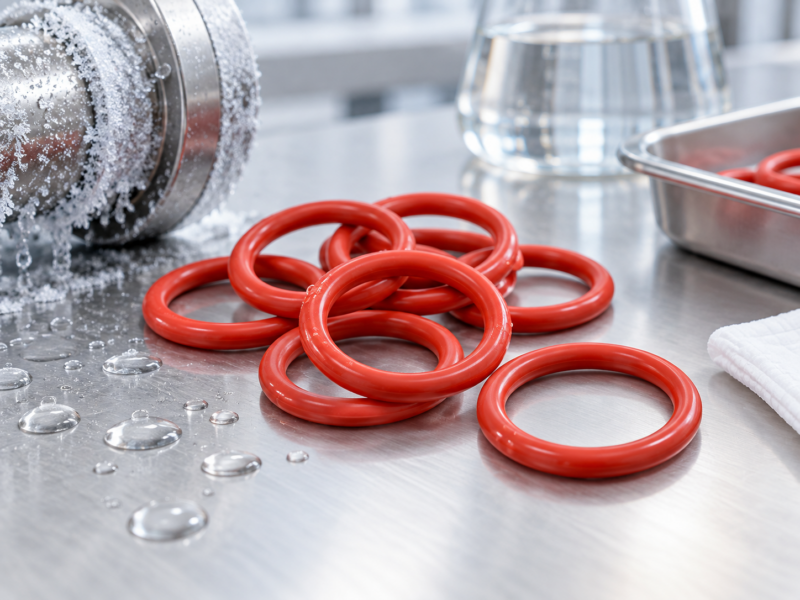
Silicone O-rings are often considered when low-temperature flexibility, resistance to outdoor weathering, or a controlled clean-service environment matters. Those strengths do not make silicone a universal sealing material. The correct decision still depends on the fluid or gas being sealed, whether the seal is static or moving, exposure to abrasion or tearing, compression behavior, groove condition, and any compound-specific cleanliness or documentation requirement.
A practical answer to when to use silicone O-rings is to screen the application in the right order: first eliminate media and mechanical conflicts, then ask whether VMQ’s low-temperature flexibility, ozone and weathering resistance, or clean-service potential solves a real application problem. This prevents a common mistake—choosing silicone from a broad temperature impression while overlooking the failure mode that will actually control seal life.
The practical answer
Low-temperature startup, outdoor exposure and cleanliness-sensitive service are three strong reasons to evaluate silicone. Unknown chemicals, frequent sliding, abrasion and tear risk are reasons to slow down and compare other O-ring materials before committing to a compound.
Start With the Application, Not the Material Name
The most useful way to decide when silicone belongs on the shortlist is to separate three different questions. First, can the seal tolerate the media it will actually contact? Second, can it survive the mechanical duty without excessive wear, tearing or installation damage? Only after those questions are reasonably clear should low-temperature flexibility, weathering resistance or clean-service requirements become the deciding advantages.
Identify every medium
Include the primary fluid or gas plus cleaners, lubricants, additives, temporary exposure and known contaminants. Compatibility can outweigh an otherwise attractive temperature or aging profile.
Define the mechanical duty
Separate static sealing from reciprocating, rotating, frequently assembled, abrasive or tear-prone service. Motion changes which material properties matter most.
Look for the silicone advantage
Then ask whether cold flexibility, ozone and weathering resistance, or a compound that can meet a defined clean-service requirement is important enough to drive the choice.
Once the operating conditions have been screened, the commercial step becomes more useful because the material discussion is tied to a real duty rather than a generic request. Engineers and procurement teams can review Silicone O-rings within the broader O-ring range while keeping the final compound decision open until media, motion and documentation requirements are confirmed.
Low-Temperature Startup and Thermal Cycling
When low-temperature flexibility is the real design constraint
Silicone O-rings for low temperature are often evaluated because VMQ can remain flexible under cold conditions where some elastomers become increasingly stiff. That characteristic can be valuable when equipment must seal immediately after a cold soak, when an enclosure sits outdoors through seasonal temperature changes, or when a joint repeatedly moves between warm and cold operating states.
The engineering question is not simply whether the elastomer remains flexible. The O-ring still has to maintain useful contact stress against the mating surfaces after the hardware and seal have changed dimension with temperature. Groove geometry, squeeze, pressure, surface condition and assembly tolerances continue to matter. A seal that looks satisfactory at room temperature may behave differently after the whole joint contracts or after a long period under compression.
Compression set should therefore be considered separately from low-temperature flexibility. A material can remain flexible in the cold while the specific compound’s recovery after prolonged compression still needs to be checked. This is especially relevant for static joints that remain assembled for long periods before a cold startup or that see repeated temperature cycles over their service life.
- The lowest normal operating condition and the lowest startup or storage condition.
- Whether the O-ring is static during cold exposure or must move immediately after startup.
- The frequency and severity of thermal cycling rather than only the coldest single event.
- Groove condition, sealing surface movement and expected squeeze across the operating range.
- The sealed media, lubricant and any cleaning fluid present at low temperature.
A useful distinction is the difference between “the polymer can remain flexible” and “this exact seal remains functional in this assembly.” The second question can only be answered after the compound, geometry and operating conditions are considered together.
Outdoor Ozone, UV Exposure and Weathering
When the surrounding environment is part of the sealing problem
Silicone is also frequently considered for weather-resistant O-rings. Ozone and weathering resistance matter when a seal is exposed to outdoor air, sunlight or long periods of environmental aging rather than being fully protected inside a lubricated assembly.
“Outdoor service” still needs to be unpacked. An enclosure seal may experience UV exposure, ozone, rain, condensation, frost and temperature cycling while seeing very little movement. Another outdoor seal may also be exposed to dust, grit, washdown chemicals, fuel residue or repeated opening and closing. Those are different sealing problems even if both parts sit on outdoor equipment.
Silicone O-rings for outdoor weathering are therefore most convincing when environmental aging is a meaningful requirement and the mechanical duty remains relatively gentle. A mostly static enclosure, electrical housing or protected connection presents a different risk profile from an exposed seal that rubs against a rough surface or is regularly removed during maintenance.
- Direct or indirect sunlight and the expected degree of UV exposure.
- Ozone exposure and whether the O-ring is continuously exposed to outside air.
- Static sealing, occasional opening or regular motion.
- Contact with rainwater, cleaners, oils, fuels, de-icing fluids or other process media.
- Dust, sand, grit or other particles that could turn environmental exposure into an abrasion problem.
The selection mistake to avoid is choosing silicone because “weather resistance” sounds appropriate while ignoring the more severe failure mechanism. If abrasion, tearing or chemical attack dominates the duty, environmental resistance may not be the property that should control material selection.
Clean Service and Applications With Specific Material Requirements
Clean service is a qualification question, not just a polymer name
Silicone O-rings for clean service may be considered where the application places unusual emphasis on cleanliness, contamination control or a documented material characteristic. The critical distinction is between the silicone material family and the finished compound. “Silicone” by itself does not establish that every formulation has the same ingredient restrictions, cleanliness characteristics, process history or approvals.
Procurement and engineering teams should first define what “clean” means in the specific system. In one application, the concern may be visible contamination or process residue. In another, the requirements may extend to extractables, particulate generation, cleaning method, packaging, traceability or documented compliance with an internal or external specification. Those requirements should exist before the seal is selected, not be inferred from its color or generic material description.
Define the process
Identify the product, gas or fluid being sealed, the equipment zone where the O-ring sits and the consequence of contamination.
Define the cleaning exposure
List cleaners, sanitizers, rinse fluids, temperatures and repeated cleaning cycles that may affect the compound.
Define the evidence
State the documentation, approval, traceability or material-control requirement that the finished compound must actually satisfy.
This is why clean-service seals should be selected from documented operating and procurement requirements rather than from the assumption that silicone is automatically appropriate for every food, medical, pharmaceutical, electronics or laboratory environment. For a critical application, ask for confirmation against the actual compound under consideration.
When Not to Choose Silicone O-Rings Blindly
Knowing when not to use silicone O-rings is part of good material selection. Low-temperature flexibility and weathering resistance can be valuable, but they do not remove mechanical limits or media-compatibility questions. Four conditions should trigger a closer review before silicone is specified.
High-wear dynamic service
Reciprocating or rotating motion introduces friction and repeated surface contact. Silicone can be less attractive when abrasion and tear resistance are major design requirements, particularly where movement is frequent or lubrication is limited.
Installation with cutting or tearing risk
Sharp edges, difficult assembly paths, excessive stretching, repeated removal or rough hardware can damage an O-ring before normal operation begins. Installation geometry should be treated as part of the material decision.
Unknown chemical media
Do not select an O-ring from temperature capability when the process fluid is uncertain. Oils, fuels, solvents, cleaners, additives and contaminants may change the compatibility decision completely.
Abrasive contamination
Dust, fibers, particles or grit can turn an otherwise reasonable environmental seal into a wear problem. Outdoor exposure and mechanical contamination should be assessed separately.
Dynamic service deserves particular care because “dynamic” covers a wide range of conditions. Stroke length, speed, frequency, pressure, surface finish, lubrication, contamination and whether the seal is reciprocating or rotating all influence wear. Silicone is not automatically excluded from every moving application, but it should not be chosen from temperature or cleanliness requirements while these mechanical details remain undefined. Gas permeability also matters: VMQ generally allows more gas permeation than several other O-ring elastomers. For vacuum duty, gas retention or strict leakage limits, assess permeation and the complete seal design before selecting a compound.
Silicone Versus Other O-Ring Materials: Compare the Decision Drivers
A useful comparison does not ask which elastomer is “best.” It asks which failure mechanism the seal must resist. Different material families prioritize different combinations of chemical compatibility, temperature behavior, mechanical strength, aging resistance, compression behavior and dynamic performance. The following questions keep the comparison tied to the application instead of turning it into a generic material ranking.
If the seal must remain compliant after low-temperature storage, startup or repeated cycling, silicone may deserve close evaluation. Confirm the complete operating envelope and the specific compound rather than relying on a generic material temperature statement.
If ozone, weathering and UV exposure are major concerns in a predominantly static seal, VMQ can be relevant. If rubbing, grit or repeated motion dominates, compare materials on abrasion and tear behavior before environmental aging.
If the O-ring contacts oils, fuels, solvents, aggressive cleaners or an unusual process fluid, compatibility should be established before temperature or weathering performance is allowed to determine the material family.
A flange, cover or enclosure seal normally sees different wear demands from a piston, rod or rotary seal. The motion profile can shift the priority from aging resistance toward friction, abrasion, tear resistance and lubrication.
If the application has cleanliness, traceability or approval requirements, define the evidence first. A material family name is not a substitute for documentation tied to the compound being purchased.
Silicone may deserve closer evaluation when…
- Low-temperature flexibility is a primary application requirement.
- Outdoor ozone and weathering exposure are meaningful design factors.
- The O-ring is static or experiences limited mechanical wear.
- The media are known and compatibility can be checked.
- A specific compound can be verified against the clean-service requirement.
Compare other materials when…
- Abrasion or frequent sliding is a major design load.
- Tearing during assembly or operation is a realistic risk.
- Chemical exposure is unknown or unusually demanding.
- Dynamic friction and contamination dominate the duty.
- Another performance requirement matters more than cold or weather resistance.
For example, a mostly static outdoor enclosure may warrant comparing VMQ with EPDM, which also offers strong ozone and weathering resistance. For compatible petroleum-oil service, NBR may be more relevant; certain oils, fuels or higher-temperature chemical duties may instead lead to an appropriate FKM grade. If fuel exposure and low-temperature flexibility are both critical, compare a suitable FVMQ compound. These are screening directions, not substitute approvals: verify compatibility, temperature and mechanical duty for the actual compound. This comparison also helps avoid over-specification. If the application does not actually need low-temperature flexibility, outdoor aging resistance or a silicone compound for a defined cleanliness requirement, there may be no reason to make silicone the default starting point. Selection should follow the duty, not familiarity with a material name.
What to Confirm Before Ordering a Silicone O-Ring
A request that contains only an O-ring size and the word “silicone” leaves important engineering questions unanswered. The information below gives a manufacturer or technical supplier a more useful basis for discussing the material, compound and size without turning uncertain assumptions into a purchasing specification.
Application information to prepare
These details also help distinguish a material problem from a hardware or installation problem. A seal that tears during assembly, wears heavily on one side, twists in the groove or loses contact after cycling may require a different design response from a seal that has simply aged outdoors.
After silicone reaches the shortlist
Once media, motion and environmental requirements are clear, review our O-ring material options and keep the final compound open until the relevant compatibility and application requirements have been confirmed. This is especially important for low-temperature cycling, dynamic wear and clean-service applications where the base polymer name alone is not enough.
Selection principle: first rule out the mechanical and media risks; then evaluate whether low-temperature flexibility, weather resistance or a verified clean-service requirement makes silicone the material family worth pursuing. That sequence is the safest way to answer when to use silicone O-rings without relying on a single attractive property.
From Application Decision to O-Ring Selection
If the operating conditions still point toward silicone after the media and mechanical checks, the next step is to compare the required size and compound with the available O-ring range. Confirm the required dimensions, compound specification and application conditions before requesting a quotation. A suitable material family is only the starting point; the finished O-ring must also fit the hardware and the operating duty.

Relevant O-Ring Range
Worth reviewing when low-temperature flexibility, outdoor weathering or a defined clean-service requirement is important and the application does not present an unresolved wear, tear or media-compatibility risk.
Confirm before ordering: actual compound, media compatibility, required dimensions, mechanical duty and any cleanliness or documentation requirement.
Review available O-ring options after the application conditions are defined, or send CBD SEALS the media, temperature, motion, environmental exposure, dimensions and documentation requirements for a material discussion.
Frequently Asked Questions
Are silicone O-rings suitable for low temperatures?
Silicone is commonly evaluated for low-temperature O-ring service because VMQ can retain flexibility in cold conditions. Final suitability still depends on the specific compound, sealed media, groove design, compression behavior, movement and the complete operating cycle.
How do silicone O-rings perform outdoors?
Silicone is often considered where ozone, UV exposure and weathering are important. Outdoor service should also be checked for abrasive contamination, chemical exposure, repeated movement and installation conditions that may create a more severe mechanical risk.
Can silicone O-rings be used in dynamic seals?
They can be evaluated, but dynamic service requires more information than a material name. Speed, stroke, frequency, surface finish, lubrication, pressure, contamination and tear risk should be reviewed because abrasion and mechanical damage may become the limiting factors.
What media details are needed before selecting silicone?
Identify the primary fluid or gas plus cleaners, lubricants, additives, process chemicals and contaminants that may contact the seal. Where relevant, also provide concentration, exposure duration, temperature and whether contact is continuous or intermittent.
When should another O-ring material be considered?
Compare other materials when abrasion, tearing, frequent dynamic wear or challenging chemical exposure matters more than silicone’s cold flexibility or weathering characteristics, or when the required compound-level cleanliness or documentation cannot be verified.